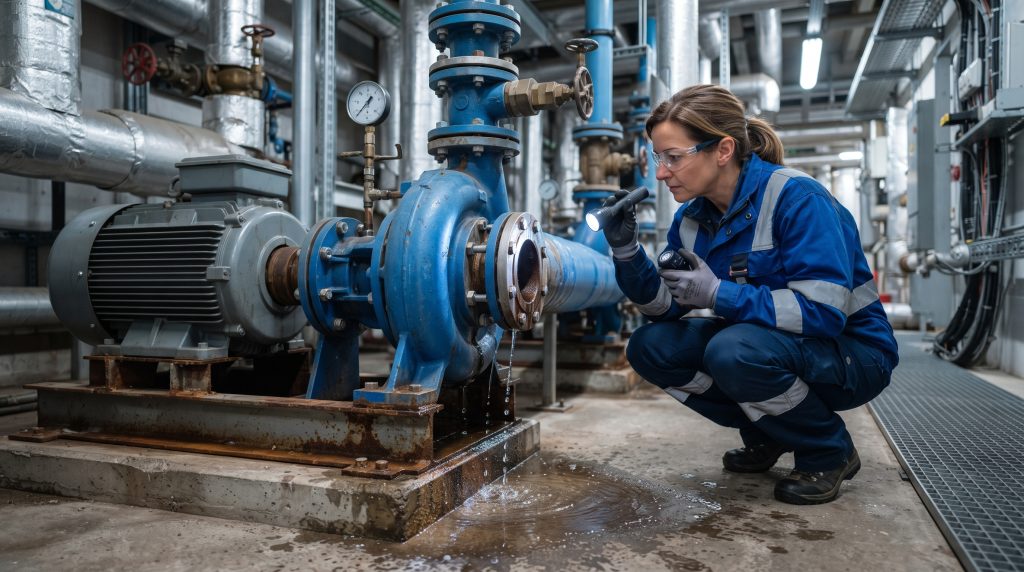
There is a quiet dread that creeps in when you walk into your pump room or glance at your equipment and spot that small, glistening puddle forming beneath the unit. At first, you might try to convince yourself it is just condensation or a little spill from earlier.
But then you look closer, and your heart sinks. That tiny pool of water is a warning. It is your pump trying to tell you something is wrong before things get catastrophic. I have stood in that spot myself, staring at a water pump leaking onto the floor, feeling the weight of knowing that every drop represents wasted energy, potential downtime, and the looming threat of a much larger failure.
Whether you are running a commercial facility, managing an industrial operation, or overseeing a maritime system, a leak is never just a leak. It is a cry for help. Let us walk through where these leaks happen, why they start, and how you can take control before that small puddle becomes a flood.
When Pump Seal Problems Turn into a Steady Drip of Water Pump Leaking
The most common place you will find a water pump leaking is right at the shaft, where the rotating shaft exits the pump housing to connect to the motor. This area is sealed by what is known as a mechanical seal, and when that seal begins to fail, you will see a telltale drip or weep coming from the weep hole or the area around the stuffing box.
This is the classic symptom of pump seal problems, and it is one of those issues that starts small but escalates quickly. The emotional journey here is one of denial turning into urgency. You see a few drops and think, “I will deal with it next week.” But pump seal problems do not heal themselves.
They worsen as the seal faces wear down, as debris scratches the surfaces, or as the elastomers harden from age and heat. What starts as a slow drip can become a steady stream in a matter of days?
The seal is the guardian between the pumped liquid and the atmosphere, and when it fails, you are not just losing water; you are risking damage to the motor, the bearings, and everything around the pump. Addressing pump seal problems early means replacing the seal before the leakage escalates into a full system shutdown.
It is a small investment compared to the cost of replacing a motor that has been flooded by a failed seal.
The Cracked Casing Catastrophe: When the Body Itself Gives Way and Water Pump Leaking Begins
Sometimes the leak is not coming from a moving part but from the pump body itself. A water pump leaking from a crack in the casing is a more serious situation because it indicates structural failure. Cast iron, bronze, or stainless steel housings can develop cracks due to freezing temperatures, excessive pressure, physical impact, or simply years of thermal cycling and vibration.
Discovering a crack in your pump casing feels like finding out your car dhas a cracked engine block. It is a gut punch. The water might be spraying out under pressure, or it might be seeping slowly from a hairline fracture that is nearly invisible to the naked eye.
The key here is understanding that pump leak causes like this often stem from environmental factors or system conditions that were overlooked. Did the system freeze last winter? Has the pressure relief valve been functioning properly to prevent over pressurization?
Is the pump mounted on a foundation that allows excessive vibration, stressing the casing over time? A cracked casing is rarely repairable with a simple patch. In most cases, it requires replacing the casing or the entire pump, which is why prevention through proper pump maintenance is so critical.
The Dripping Flange: When Connections Come Undone
Not every leak comes from inside the pump itself. Sometimes the culprit is right where the pump connects to the rest of the world. Flanges, threaded fittings, and union connections are all potential failure points where you might discover a water pump leaking.
These connections rely on gaskets, O rings, or pipe dope to create a watertight seal, and when these materials degrade over time, the water finds a way out. There is a special kind of frustration that comes with a leaky flange. You know the pump is fine, the motor is fine, but you are still mopping up water because a $5 gasket has failed.
The water often drips or sprays from the joint, especially on the discharge side where pressure is highest. Pump leak causes at connections usually boil down to improper installation, overtightening that crushed the gasket, under tightening that left a gap, or simply the natural aging of rubber and fiber materials.
The emotional toll is the feeling of being nickel and dimed by small parts that cause big headaches. The solution is often straightforward: replace the gasket, reapply sealant, or retorque the bolts to specifications. But it serves as a reminder that even the simplest components require attention during regular pump maintenance rounds.
The Weep Hole Warning: When the Internal Seal Sends a Signal
Many centrifugal pumps are designed with a weep hole or telltale hole located between the stuffing box and the bearing housing. This hole serves a specific purpose: it gives you a visible warning when the internal seal is failing. If you see a water pump leaking from this weep hole, do not ignore it.
That hole is doing its job by letting you know that the primary seal has failed and water is escaping past it. This is actually a gift, even though it does not feel like one in the moment. The weep hole is designed to prevent water from traveling further down the shaft and destroying the bearings.
When you see water coming from that hole, you are catching the problem at a stage where pump seal repair is still the solution, rather than bearing replacement or motor overhaul. The emotional shift here is from panic to gratitude if you understand what is happening.
You have been given an early warning. Now is the time to act, to call in the experts, and to schedule that pump seal repair before the leakage migrates to the bearings and turns a manageable repair into a major rebuild.
The Gland Leak: When Packing Needs Attention
For pumps that use packing instead of mechanical seals, a small amount of leakage is actually normal and even necessary. Packing relies on a controlled drip to lubricate and cool the packing material. But when that controlled drip becomes a steady stream, you are dealing with a pump seal leak that requires adjustment.
The packing gland is the assembly that compresses the packing rings around the shaft, and when it is too loose, water gushes out. When it is too tight, the packing overheats and burns up. Finding the sweet spot with packing is an art form. Too little leakage and you risk damaging the shaft sleeve from friction and heat.
Too much leakage and you are wasting water, creating a mess, and potentially eroding the packing material. Pump leak causes related to packing often come down to improper adjustment or worn packing that has lost its resilience. If you are constantly adjusting the gland nuts and the leak persists, it is likely time to replace the packing rings entirely.
This is a routine part of pump maintenance that keeps older pumps running reliably without the need for a full mechanical seal conversion.
The O Ring Oversight: When Static Seals Fail
Beyond the shaft seal and the packing gland, there are numerous static seals throughout a pump assembly. O rings seal the volute casing to the backplate, seal the bearing housings, and seal various access ports. When one of these O rings fails, you get a water pump leaking from a location that can be confusing to diagnose.
The water might seem to be coming from the middle of the pump body, from a seam, or from a seemingly random spot. These leaks are often slow and intermittent, making them particularly annoying to track down. You dry everything off, watch for the source, and then discover that the water is seeping from a seam where two pump halves meet.
The emotional experience is one of detective work, chasing a ghost that appears and disappears. Pump seal problems of this nature usually require disassembly to replace the O ring. It is a labor intensive repair for a part that costs pennies, which is why many operators put it off until the leak becomes unbearable.
But the cost of ignoring it is continued water waste, potential corrosion of surrounding components, and the risk that the O ring will fail completely at the worst possible moment.
The Bearing Housing Breach: When Oil and Water Mix
One of the more serious signs of a water pump leaking is when water shows up in the bearing housing or oil shows up in the pumped fluid. This indicates that the seals separating the wet end from the bearing housing have failed completely. Water entering the bearing housing washes away lubrication, leading to rapid bearing failure, heat generation, and eventually, catastrophic seizure of the rotating assembly.
Finding milky oil in your bearing housing or noticing that your pump is running hotter than usual is a moment of realization that things have progressed beyond a simple leak. The water has breached the final defense.
At this point, when to repair pump becomes not a question of if, but how urgently. Continuing to run a pump with water contaminated bearings is a gamble that almost always ends in a seized shaft and a much larger repair bill. Recognizing this as the sign that you have reached the limit of temporary fixes is crucial.
It is time to stop the equipment and call for professional pump seal repair before the damage extends to the shaft, bearings, and housing.
Trust The Experts Who Know Where Leaks Hide
You do not have to become a leak detective on your own. Watching a water pump leaking day after day, trying to convince yourself it is not that bad, only to have it turn into a major failure is a cycle that drains your time, your budget, and your peace of mind.
With over four decades of experience right here in Houston, we have seen every type of leak imaginable. From the slow weep of pump seal problems to the sudden spray of a cracked casing, we know exactly where to look and how to fix it right the first time.
We understand the pressure you are under to keep your facility running. That is why we combine the latest diagnostic technology with old fashioned expertise to get to the root of your leak quickly. Whether you need routine pump maintenance to prevent leaks before they start, or you are already facing a leak and need to decide when to repair pump, our certified team is here to guide you.
We offer seamless pump seal repair and comprehensive flow control solutions for industrial and maritime clients across Houston. You should not have to live with puddles on your floor and worry in the back of your mind. Let us handle the leaks so you can focus on what you do best.
Don’t Let a Small Leak Flood Your Peace of Mind
A water pump leaking is never just a minor inconvenience. It is a symptom of something deeper, a warning that your equipment needs attention before a small problem becomes a crisis. Whether the water is dripping from the shaft seal, seeping from a cracked casing, or pooling around a loose flange, every drop tells a story about the health of your system.
You have worked too hard to build your operation to let a preventable leak steal your momentum. By understanding where leaks happen and why they start, you empower yourself to act quickly, call in the right help, and protect your investment. The next time you spot that puddle, do not look away.
Face it head on, address the root cause, and restore the reliability your system was built to deliver. You have got this, and when you need a partner who knows the ins and outs of flow control, we are right here in Houston ready to help.