Have you ever been in your facility, trying to focus on the work at hand, only to be distracted by that maddening sound? Click. Whir. Click. Whir. Over and over again, your pump starts, runs for a few seconds, shuts off, and then immediately fires back up. It is enough to drive anyone crazy.
But beyond the annoyance, there is a deeper worry gnawing at you. You know this constant starting and stopping cannot be good for the equipment. Every time that motor kicks on, it draws a surge of electricity, puts stress on the components, and pushes your system one step closer to failure.
When your pump short cycling, it is not just an irritating noise; it is a cry for help from a system that is struggling to do its job. I have been in those pump rooms, standing there counting the seconds between cycles, feeling the frustration build with every start.
The good news is that pump cycling problems almost always have a clear cause, and once you understand what to look for, you can stop the madness and restore your system to smooth, reliable operation.
When The Air Cushion Disappears and Pump Short Cycling Begins
If you have a pressure tank in your system, this is the first place you should look when dealing with pump short cycling. Pressure tanks use a cushion of compressed air to separate the pump from the system demand. When the pump runs, it fills the tank, compressing the air until the pressure reaches the cutoff point.
Then, when you open a tap, that compressed air pushes water out, allowing the pump to rest between cycles. But here is the thing: air dissolves into water over time. Slowly, that air cushion erodes, and the tank becomes waterlogged.
When a tank is waterlogged, there is no air to absorb the pressure changes. The moment you open a tap, the pressure drops instantly, and the pump kicks on. The moment you close the tap, the pressure shoots up, and the pump kicks off. The result is rapid, relentless pump cycling problems that can happen in seconds.
The emotional toll here is watching your pump work itself to death, starting and stopping more times in an hour than it should in a week. Checking the tank’s air charge with a tire pressure gauge is a simple diagnostic step. If the pressure is low or water comes out of the valve when you depress it, you have found your culprit. Recharging the tank or replacing a failed internal bladder can instantly silence the cycling and give you back your peace of mind.
When The Brain of The System Malfunctions and Causes Pump Short Cycling
The pressure switch is the brain of your pumping system. It tells the pump when to start and when to stop based on the pressure readings it detects. When this component begins to fail, you get all kinds of erratic behavior, including the dreaded pump turns on off cycle that never seems to end. Pressure switches can fail in several ways.
The contacts can become pitted and welded together, causing the pump to run continuously. The diaphragm can develop a pinhole leak, causing the switch to sense pressure incorrectly. Or the sensing tube can become clogged with debris, sending false signals to the switch.
Troubleshooting pump short cycling caused by the pressure switch is equal parts detective work and frustration. You might watch the gauge climb to the cut off pressure, but the switch does not open. Or the pressure drops below the cut in point, but the switch does not close.
The emotional experience is one of watching a system that seems to have a mind of its own, ignoring the rules it was designed to follow. Sometimes the issue is as simple as a dirty contact that needs cleaning. Other times, the switch has reached the end of its life and needs replacement.
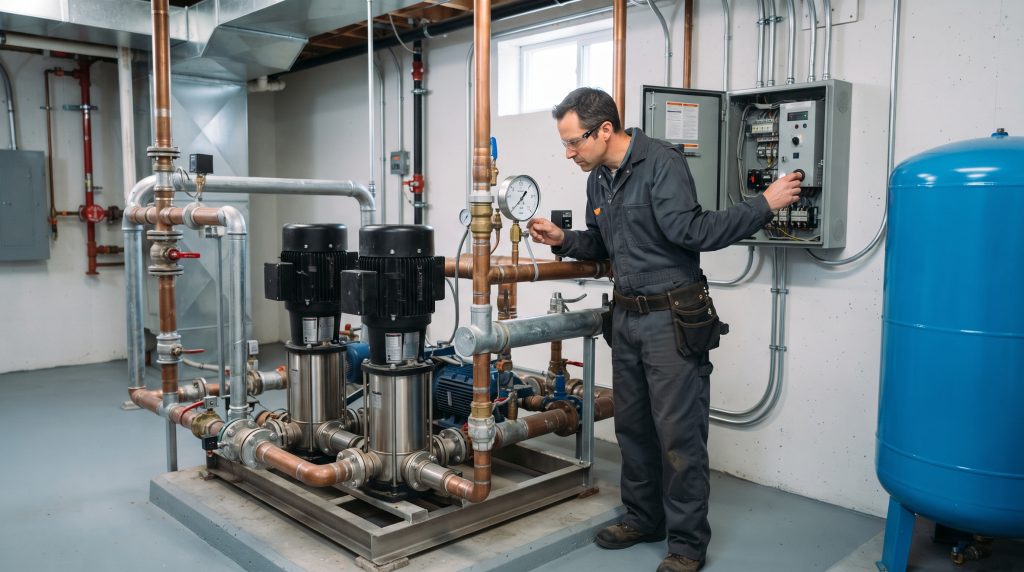
In more complex systems, the pump control panel houses the pressure switch and other control components, and issues here require a trained eye to diagnose properly.
The Leaky System Problem: When Water Is Going Where It Should Not
Here is a scenario that will test your patience. The pump cycles on and off, but you cannot find any water running anywhere. No open taps, no obvious leaks on the floor. Yet the pump keeps running. This is often caused by a hidden leak somewhere in the system, allowing water to escape slowly and causing the pressure to drop just enough to trigger the pump.
The leak could be underground, behind a wall, or even inside a toilet that is silently running without anyone noticing. The stress of dealing with a hidden leak is immense. You know something is wrong because the pump will not stop cycling, but you cannot see where the water is going.
This is the classic scenario of pump running no flow combined with cycling, because the pump is moving water, but that water is disappearing into the ground or the drain instead of serving its intended purpose. Finding these leaks often requires isolating sections of the system and monitoring pressure loss over time. It is tedious work, but necessary.
Because until that leak is found and fixed, the pump cycling problems will continue, wearing down your equipment and running up your utility bills with every wasted gallon.
The Bladder Failure Blues: When the Internal Barrier Breaks
Many modern pressure tanks use a bladder or diaphragm to separate the air from the water. This design prevents the air from dissolving into the water, which means the tank maintains its air charge much longer than older style tanks. But bladders are not indestructible.
They can tear, rupture, or simply lose their elasticity over time. When a bladder fails, the tank becomes waterlogged almost immediately, and you are back to dealing with pump short cycling. There is a particular frustration when a bladder fails because the tank itself looks fine from the outside. No visible damage, no leaks, nothing to suggest that the internal component has given up.
But the symptoms are unmistakable. The pump cycles rapidly, the pressure gauge jumps erratically, and you feel like you are losing your mind trying to figure out what changed. The solution, unfortunately, is usually tank replacement. Bladder style tanks are not typically designed to be repaired.
While this feels like a major expense, it is important to remember that a properly sized tank with a functioning bladder will extend the life of your pump dramatically by reducing cycle frequency. Investing in a new tank is often cheaper than replacing a pump that has been destroyed by excessive cycling.
The Float Switch Failure: When Level Controls Go Haywire
In sump pumps, sewage pumps, and many industrial applications, the pump is controlled by a float switch that responds to the water level in a tank or pit. When the float rises to a certain point, the pump turns on. When the level drops, the pump turns off. But float switch problems can cause all sorts of cycling issues.
A float that is stuck in the closed position will keep the pump running even when the level is low. A float that is stuck in the open position will never turn the pump on, leading to overflow. And a float that is hanging up on debris or the side of the pit can cause the pump to cycle on and off rapidly as the float teeters on the edge of its activation point.
Dealing with float switch problems often means getting your hands dirty. You have to open the pit or tank, inspect the float mechanism, and make sure it is moving freely through its full range of motion. This is one of those tasks that is simple in concept but can be physically demanding and unpleasant, especially in sewage applications.
The emotional relief when you free a stuck float and the pump returns to normal operation is significant. But if the switch itself is faulty, you may need to consider pump control repair to replace the float assembly or upgrade to a more reliable control system.
The Undersized System Struggle: When Demand Exceeds Capacity
Sometimes the problem is not a failure at all. Sometimes the issue is that your system was never properly sized for the demand it is trying to meet. If you have added new fixtures, expanded your facility, or increased your water usage in any way, your existing pump and tank setup may simply be too small to handle the load.
The result is pump cycling problems because the pump cannot keep up with the demand long enough to reach the cut off pressure and rest. This situation is frustrating because nothing is technically broken, yet your system is failing to perform. You might find yourself standing there, watching the pump cycle endlessly, wondering how you ended up with a system that works against you instead of for you.
The emotional weight here is the realization that you need to invest in an upgrade, something that was probably not in the budget. But the truth is, running an undersized system will kill your pump prematurely. The constant starting and stopping generates heat, wears out the motor windings, and stresses every component.
A properly sized system, designed to match your actual demand, will run smoothly, cycle appropriately, and give you years of reliable service.
The Control Panel Chaos: When Electronics Go Rogue
In modern pumping systems, the pump control panel is the central nervous system. It manages start and stop sequences, monitors pressures and levels, and protects the pump from dry running, over current, and other damaging conditions. When the control panel malfunctions, you can get all kinds of bizarre behavior, including rapid cycling, failure to start, or failure to stop.
Troubleshooting control panel issues requires a level of expertise that goes beyond basic mechanical knowledge. You are dealing with relays, contactors, timers, and potentially programmable logic controllers. The stress of staring at a panel full of components, not knowing which one is causing the problem, is real.
This is often the point where DIY troubleshooting ends and professional pump control repair begins. A certified technician can diagnose whether the issue is a failed relay, a loose connection, a faulty pressure transducer, or a programming glitch.
Getting the control panel sorted out not only stops the cycling but ensures that your pump is protected from other damaging conditions that could lead to a catastrophic failure down the road.
Let Us Help You Break the Cycle
You should not have to live with a pump that starts and stops like a nervous tic. The constant cycling wears on your nerves and your equipment, and it never seems to stop until something finally gives. With over four decades of experience right here in Houston, we have seen every variation of pump short cycling you can imagine.
From waterlogged tanks to failing pressure switches, from float switch problems to complex pump control panel issues, our certified team knows exactly how to get to the root of the problem and restore your system to smooth, reliable operation.
We understand that you have a facility to run, a team to manage, and a thousand other things demanding your attention. That is why we focus on fast, accurate diagnosis and lasting repairs. Whether you need a simple pressure tank recharge or comprehensive pump control repair, we bring the same level of expertise and care to every job.
You do not have to be a pump expert to keep your system running. That is what we are here for. Let us handle the pump cycling problems so you can focus on what you do best, with the confidence that your equipment is in good hands.
Break The Cycle: Stop Pump Short Cycling and Restore Your Sanity
A pump that will not stop cycling is more than an annoyance. It is a warning that your system is under stress, working against itself, and heading toward an early failure. Whether the culprit is a waterlogged tank, a faulty pressure switch, a hidden leak, or a control panel that has lost its way, every rapid cycle brings your pump one step closer to burnout.
You have invested too much in your operation to let a preventable issue wear down your critical equipment. By understanding the common causes of pump short cycling, you can take action early, call in the right help when needed, and restore the smooth, efficient operation your system was designed to deliver.
The next time you hear that click whir click whir rhythm, do not let it drive you crazy. Face it head on, diagnose the root cause, and break the cycle for good. You have got this, and when you need a partner who knows the ins and outs of pump systems, we are right here in Houston ready to help.