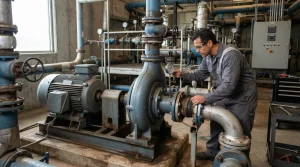
You know that sinking feeling, right? The one that hits when your best pump motor gives up the ghost in the middle of a critical production run. Maybe it started with a strange hum, or perhaps you walked by and just caught a whiff of that unmistakable burnt electrical smell.
Now you are standing there, looking at a dead piece of equipment that brings your entire operation to a screeching halt. Your phone is already ringing, deadlines are looming, and the pressure is on to make a call. Do you rush it to a shop for a rebuild, or do you bite the bullet and order a brand new one?
It is one of the most stressful decisions a facility manager has to make, and honestly, it keeps a lot of people up at night. It is not just about fixing what is broken; it is about money, time, and trust. Do you trust that your old motor has more life left in it, or do you invest in something fresh off the line?
I have been in this industry long enough to know that there is no universal answer, but there is a right answer for your specific situation. Let us walk through this together and take the guesswork out of your motor replacement decision.
The Million Dollar Question: The Rebuild vs Replace Motor Dilemma
When a critical motor fails, your brain starts racing. You look at the budget, you look at the clock, and you look at the burnt windings. The famous dilemma of rebuild vs replace motor is one of the oldest arguments in industrial maintenance. Some old school operators will tell you that they never buy new, that rebuilding is always cheaper.
Others swear that new equipment is the only way to guarantee reliability. The truth, as always, sits somewhere in the messy middle. The decision hinges on several factors that go far beyond just the price tag. You have to consider the age of the motor, the availability of replacement parts, and the criticality of the application.
If that motor runs a secondary pump that only kicks in during emergencies, you have more wiggle room. But if it is the heart of your main slurry line, you need a solution that offers absolute reliability. It is a high stakes puzzle, and the wrong move can cost you dearly in downtime.
Understanding Motor Rebuild Cost vs New Price
Let us talk about the elephant in the room: money. When you first look at a quote for a motor rebuild service, it often looks a lot friendlier than the invoice for a brand new high efficiency motor. That initial price difference can be very tempting. But you have to look deeper than the bottom line. A quality rebuild isn’t just slapping on some new bearings and calling it a day.
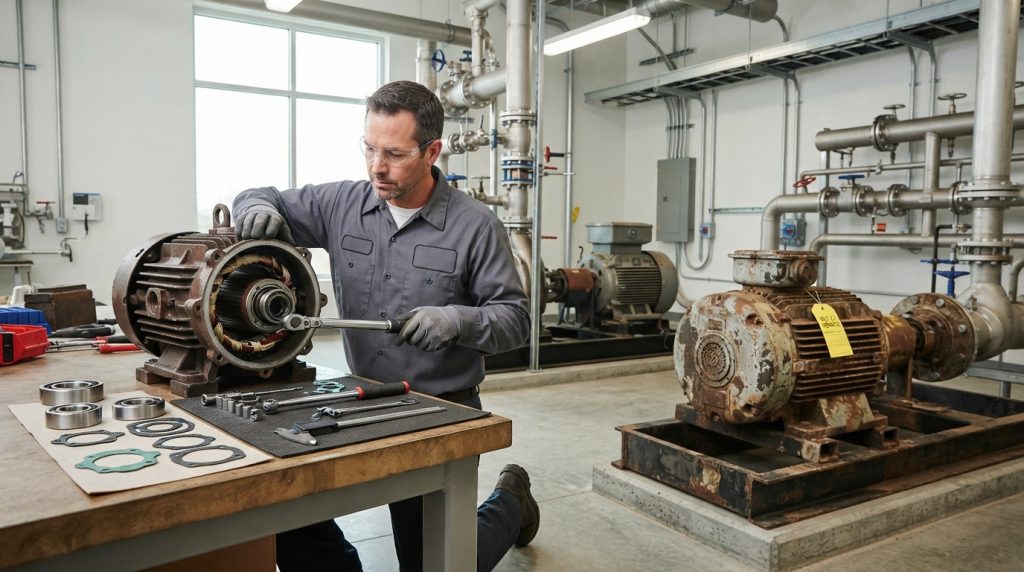
A proper rebuild involves stripping the motor down to its core, inspecting the rotor, testing the stator, and completely rewinding the copper. The motor rebuild cost reflects the labor and skill of certified technicians who understand the history of your equipment.
However, you also have to ask yourself: what am I getting for my money? A rebuilt motor comes with a history. A new motor comes with a clean slate. If your motor has been through hell, if it has been flooded or repeatedly overheated, the core iron itself might be damaged or annealed, meaning it has lost its magnetic properties.
In that case, even the cheapest rebuild is a waste of money because the heart of the motor is already dead.
Why Downtime Dictates Your Motor Replacement Decision
Sometimes, the decision is made for you by the hands of a clock. In the world of industrial maintenance, time is the one currency you cannot print more of. If your motor fails on a Tuesday and a motor rebuild service can have it back to you by Thursday, but a replacement motor is sitting in a warehouse in another state with a two week lead time, the choice becomes obvious.
You have to keep the lights on. However, there is a trap here. You have to honestly evaluate how long motors last after a rushed repair. A rebuild that is done in a hurry to meet a deadline, using old or substandard parts, might get you running quickly, but it could fail again just as fast.
This is where the motor replacement decision gets emotional. You want your plant running now, but you also want to sleep soundly next week without worrying about another failure. If you choose to replace, you are often buying peace of mind and a warranty.
If you choose to rebuild, you are betting on the skill of the technicians and the inherent quality of the original core.
Signs That You Should Repair or Rebuild Your Motor
There are definitely times when rebuilding is the smarter, more strategic move. If you have a motor that is considered “premium” or if it is a special frame size that is no longer manufactured, you almost have no choice but to seek out a motor rebuild service.
Additionally, if the failure is minor, such as a bad bearing, a failed seal, or a simple connection issue, you would be foolish to scrap the whole thing. In these cases, the decision to replace or repair motor components is a no brainer. Repairing saves the majority of the motor’s life and gets you back in action for a fraction of the cost. Also, consider the physical footprint. If your motor is mounted on a custom baseplate with specific piping alignments, swapping in a new motor from a different manufacturer might require expensive modifications to the foundation, couplings, and electrical connections.
These “hidden costs” can quickly tip the scales in favor of a rebuild, making it the most practical and economical path forward.
The Case for Investing in High Efficiency Motors
On the flip side, there are moments when holding onto the past is actually holding you back. Technology has come a long way in the last decade. If your motor is more than 15 or 20 years old, the efficiency standards of today blow the old models out of the water.
Upgrading to one of the latest high efficiency motors can significantly lower your plant’s energy consumption. These motors run cooler, vibrate less, and are built to tighter tolerances. If you are constantly dealing with pump motor overheating issues on an old motor, replacing it with a modern, efficient model might solve those thermal problems permanently.
Furthermore, if the motor frame or shaft is damaged beyond repair, or if the winding insulation is completely fried from a lightning strike or phase failure, the cost to rebuild might approach 60% or 70% of the cost of new. Industry experts often say that if the repair cost exceeds 60% of the replacement cost, and the motor is not a rare antique, you should always buy new.
You get a fresh warranty, better efficiency, and zero hours of run time on the components.
The Core of the Matter: Assessing Physical Damage and Wear
You cannot make a smart motor replacement decision without getting your hands dirty. You have to look inside the beast. When we get a failed motor in our shop, the first thing we do is listen to the story the parts tell us. Are the bearings discolored from heat?
Is the shaft sleeved or worn down? If the rotor is rubbing against the stator, a condition we call “machining,” the internal clearances are shot. In severe cases, the laminations on the rotor can short together, creating hot spots that no amount of rebuilding can fix.
Also, consider the environment. Has this motor been living in a chemical plant where corrosive vapors have eaten away at the internal casing? If the structural integrity of the housing is compromised, a rebuild is just putting a Band Aid on a broken leg.
You have to be brutally honest about the physical state of the equipment, not just its electrical functionality.
Navigating the Gray Areas: What About Custom and Specialty Motors?
Now, let us talk about the curveballs. What if you are dealing with a motor that runs a vertical turbine pump? What if it is a wash-down duty motor for a food processing plant? These specialty motors often come with long lead times and high price tags.
In these cases, the motor rebuild cost almost always wins. Because these motors are built for specific harsh environments, finding a direct replacement “off the shelf” is nearly impossible. If you have a motor with a special shaft extension, a unique flange mounting, or a rare voltage configuration, protecting that asset through professional rebuilding is the smartest move you can make.
It protects your warranty on the driven equipment and ensures that the mechanical seals and couplings remain perfectly aligned. Sometimes, the devil you know is better than the devil you don’t, and a rebuilt motor with a known history is far more valuable than a mystery box from a supplier.
Choosing the Path That Keeps Your Plant and Your Conscience Clear
At the end of the day, standing at that crossroads wondering whether to rebuild or replace your motor is never easy. It is a decision that mixes hard data with gut feeling, spreadsheets with sweat equity. Whether you are stressing over the immediate motor rebuild cost or looking longingly at the specs of the latest high efficiency motors, remember that you don’t have to make the call alone.
The best path forward is the one that keeps your operation safe, your production on schedule, and your maintenance budget intact. Sometimes that means giving a trusted workhorse a second life through a professional motor rebuild service, and sometimes it means retiring it with honor and investing in the future.
Our team has spent over forty years helping folks right here in Houston navigate these exact waters. We understand the pressure you are under because we live in the same industrial world you do.
So, take a breath, look at the facts, and make the choice that lets you go home at the end of the day knowing your plant is ready for whatever tomorrow brings.