You walk into your mechanical room, and something feels off. At first, you are not sure what it is, but then you feel it through the soles of your feet. A subtle rumble that was not there before. You place your hand on the pump, and it confirms your suspicion. Your equipment is shaking.
Maybe it is a gentle tremor you have been ignoring for weeks, hoping it would go away on its own. Maybe it has gotten so bad that you can hear pipes rattling and feel the vibration all the way up through the floors above. I have been in this business long enough to know that feeling of dread when you realize your pump is not running the way it should.
That shaking is not just annoying. It is your equipment screaming for attention before something catastrophic happens. As the team recognized throughout NYC and NY as the #1 pump repair company, we have diagnosed thousands of pump vibration issues across commercial and industrial facilities.
I am going to walk you through what causes that shaking, how serious it really is, and exactly what you need to do about it before a small problem turns into a full system failure.
When Pump Vibration Starts: Why Your Equipment Is Shaking and What It Means
Let me be straight with you. A properly installed and balanced pump should run smoothly. You should hear a steady hum, maybe feel a gentle operational rhythm, but you should never feel your equipment shaking violently or vibrating in a way that transfers through your floor or piping.
When pump vibration appears, it is always a sign that something is wrong. The severity of that vibration tells you how urgently you need to act. A minor tremor might indicate the beginning of a vibration problems pump issue that you can address before major damage occurs.
A violent shake that you can see and hear from across the room means you need to shut that pump down immediately before it tears itself apart. I have walked into facilities where operators kept running a pump with excessive pump vibration for weeks because they were too busy to call someone.
By the time we arrived, the pump shaking had destroyed bearings, cracked the baseplate, and even damaged the piping connected to the unit. What could have been a simple realignment turned into a costly replacement. Do not let that be you. When your pump starts vibrating, treat it like a check engine light on your car. It is trying to tell you something important.
How Misaligned Shafts Create Dangerous Pump Vibration and Destroy Your Equipment
If I had to pick the single most common cause of pump vibration I see in the field, this would be it. Misalignment between your pump and motor is a silent killer. When these two components are not perfectly aligned, every rotation creates a force that tries to push them apart.
That force translates into pump vibration, and over time, it destroys couplings, wears out bearings, and puts stress on seals that leads to leaks and premature failure. I cannot tell you how many service calls I have been on where a customer told me their pump was making noise and vibrating, only for me to find that the alignment was off by a fraction of an inch.
That tiny misalignment created enough excessive pump vibration to cause thousands of dollars in damage. Proper pump alignment is not optional. It is essential. When a pump and motor are perfectly aligned, they run smoothly, quietly, and efficiently. When they are not, they fight each other every single second they are running.
If you are experiencing pump vibration, especially if it seems to have started after a repair or maintenance event, alignment should be one of the first things you check. Professional pump alignment requires precision tools and experience.
Guessing with a straight edge is not good enough when your equipment and your facility are on the line.
When Pump Making Noise Means Bearing Failure Is Near
That shaking you feel is often accompanied by sound. Maybe you have noticed your pump making noise that was not there before. A low growl. A high pitched squeal. A grinding sound that makes you cringe every time the pump cycles. These sounds are your warning system.
When a pump making noise coincides with pump vibration, you are likely looking at bearing issues. Bearings are the unsung heroes of your pump system. They allow the shaft to spin smoothly with minimal friction. But bearings wear out over time. They get contaminated by moisture or debris.
They lose their lubrication. And when they start to fail, they produce heat, noise, and vibration. If you ignore a pump making noise and the vibration that comes with it, you are heading straight toward motor bearing failure. I have seen motor bearing failure take out not just the bearings themselves, but the shaft, the housing, and even the motor windings when things get hot enough.
When motor bearing failure occurs, what could have been a bearing replacement turns into a full motor overhaul or replacement. Do not let that happen. That noise and vibration are your pump begging for attention before it breaks down completely.
When Internal Components Are the Vibration Source
Sometimes the source of pump vibration is inside the pump itself. The impeller, the part that actually moves the water, needs to be perfectly balanced to spin smoothly. If that impeller becomes unbalanced, every rotation creates a wobble that translates into vibration.
How does an impeller become unbalanced? Sometimes debris gets lodged in the impeller vanes, throwing off the balance. Sometimes the impeller erodes unevenly over time, especially if you are pumping water with abrasives like sand or sediment. Sometimes a previous repair involved replacing the impeller with one that was not properly balanced for your specific pump.
I have also seen cases where the rotor inside the motor became unbalanced, creating pump vibration that people assumed was coming from the pump itself. Diagnosing internal imbalance requires experience and the right tools. You need to isolate the components, test them individually, and determine where the imbalance actually lives.
This is one of those situations where guessing can make things worse. If you have ruled out alignment and mounting issues and your excessive pump vibration persists, it is time to consider that the problem might be inside the pump or motor.
Loose Mounting and Weak Foundations: When Your Pump Is Fighting Its Own Base
I have walked into mechanical rooms where the pump vibration was so bad that the entire pump was visibly bouncing on its base. When I looked closer, I found that the mounting bolts had loosened over time, allowing the pump to shift and vibrate.
Sometimes the base itself was the problem. A concrete pad that was not properly reinforced. A steel base that had rusted and weakened. Even the floor underneath the pump settling or shifting can create conditions for pump shaking. Your pump needs a solid, rigid foundation to operate correctly. If the foundation moves, the pump moves.
If the pump moves, it creates more vibration. And more vibration loosens the foundation further. It is a vicious cycle that only gets worse over time. When you are dealing with pump vibration, take a good look at how your equipment is mounted.
Are the bolts tight? Is the base intact and free of cracks or rust? Is the floor underneath stable? Sometimes the fix is as simple as tightening bolts or adding vibration dampening pads. But if the foundation itself is compromised, you may need to address that before any other repairs will hold.
How Your Pipes Can Cause Pump Vibration and Damage?
Here is something that surprises a lot of facility managers. The pipes connected to your pump can be a major source of pump vibration. When pipes are not properly supported, they put stress on the pump flanges. That stress pulls the pump out of alignment and creates vibration.
When pipes are rigidly connected without flexible connectors, every vibration from the pump transfers directly into the piping system, and every vibration from the piping system transfers back into the pump. It becomes a feedback loop of excessive pump vibration that damages both the pump and the piping. I have seen cases where poor pipe support caused pump vibration so severe that it cracked pipe welds and caused leaks throughout the system. Proper piping support, flexible connectors, and expansion joints are not optional extras.
They are essential components of a system that will run smoothly and reliably. If you are experiencing pump vibration that seems to resonate through your pipes, take a look at how your piping is supported. Are there hangers every few feet?
Are there flexible connectors at the pump flanges? Is there strain on the connections that is pulling the pump out of alignment? Addressing piping stress can sometimes solve vibration problems pump issues that nothing else seemed to fix.
When To Call for Pump Vibration Repair: Stop the Shaking Before It Stops You
You have read through the possibilities. You have checked alignment, looked at mounting, considered internal issues, and examined your piping. But that pump vibration is still there, and you are starting to worry about how much longer your equipment can hold up.
This is the moment to call for professional pump vibration repair. Trying to diagnose and fix vibration issues without the proper tools is like trying to find a leak in a dark room with no flashlight. You might stumble onto something, but you are just as likely to make things worse.
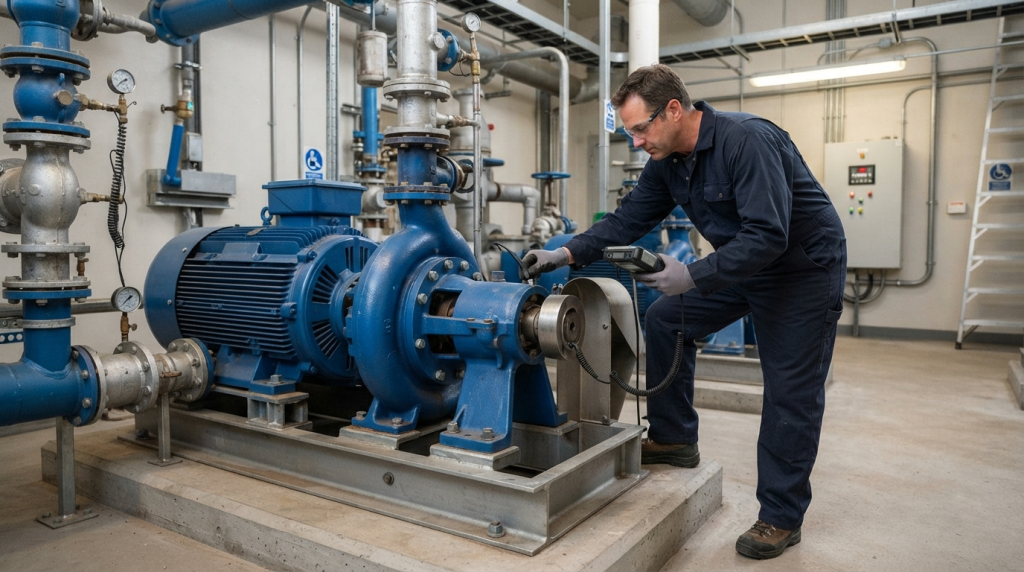
Professional pump vibration repair starts with proper diagnosis. We use vibration analysis tools that can pinpoint exactly where the vibration is coming from and what frequency it is operating at. That data tells us whether the issue is alignment, imbalance, bearing failure, or something else entirely.
Once we know the root cause, we can perform the pump vibration repair that actually fixes the problem, not just treats the symptoms. As the leading experts in pump repair across NYC, NY, NJ, and PA, we have the tools, the experience, and the dedication to get your system running smoothly again.
From Shaking to Smooth, Getting Your Pump Back on Solid Ground
That moment when you first noticed your pump shaking probably made your stomach drop a little. You knew something was wrong, even if you could not put your finger on it. And now that you have read through this guide, you understand just how serious pump vibration can be.
But here is what I want you to take away from this. Vibration is not a mystery. It is a symptom with identifiable causes. Maybe it is pump alignment that drifted over time. Maybe it is motor bearing failure that has been building for months. Maybe it is an impeller that has become unbalanced or a base that has loosened.
Whatever the cause, it is something that can be diagnosed and fixed. You do not have to live with excessive pump vibration until your equipment destroys itself. You do not have to worry every time you walk into your mechanical room, wondering if today is the day your pump finally gives out. You now have a roadmap to figure out what is wrong, and you know when it is time to call in the professionals. When that time comes, we are here to help.
Let us take the shake out of your system and get your pump running the way it should, smooth, steady, and reliable for years to come.