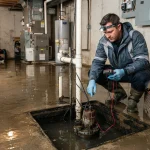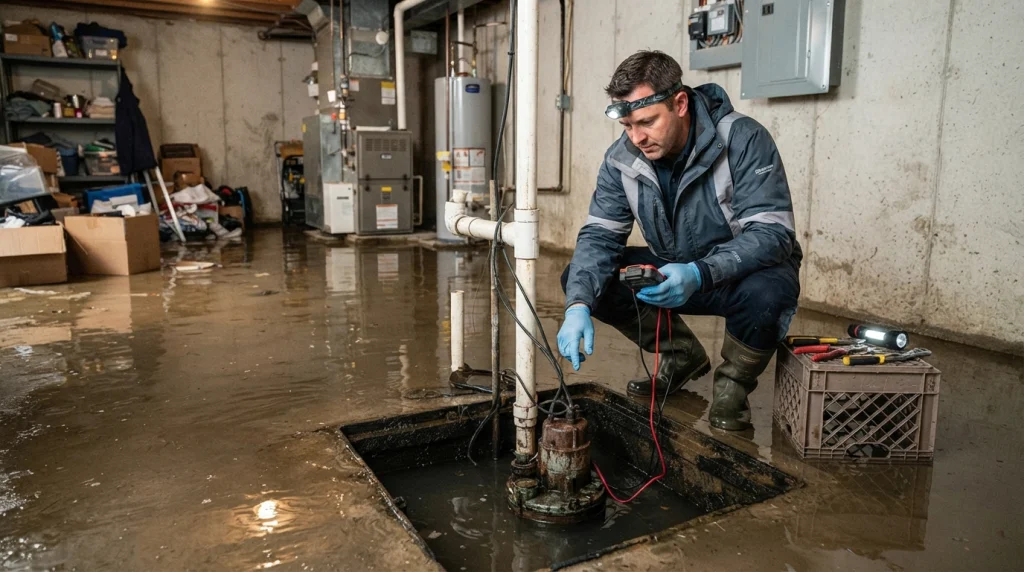
It starts with a sound you do not want to hear. Maybe it is the middle of the night, and you are jolted awake by the shriek of your pump making noise in a way you have never heard before. Or maybe you walk downstairs to grab something and feel that sickening splash of water covering your basement floor.
In that moment, your heart drops. You know exactly what has happened. Your pump has failed, and water is coming in faster than you can even process. If you are facing a basement flooding emergency right now, I need you to take a breath. I know the panic.
I have been there with countless property owners across NYC, standing in basements with water rising around our boots, trying to figure out the fastest way to stop the chaos. As the team recognized throughout NYC and NY as the #1 pump repair company, we have responded to more sump pump failure flooding emergencies than I can count.
The next few minutes are critical. What you do right now determines whether this is a minor inconvenience or a catastrophic loss. Let me walk you through exactly what to do when water starts rising.
When Basement Flooding Emergency Strikes: Your First Three Moves Matter Most
I need you to understand something right away. In a basement flooding emergency, every second counts. Water does not wait. It does not slow down because you are stressed or overwhelmed. It keeps coming, and every minute you waste makes the damage worse.
So let us talk about your first three moves. First, get to your electrical panel and shut off power to the area. Water and electricity are a deadly combination, and you cannot help anyone if you get hurt.
Second, if your pump is still running but struggling, or if it has stopped completely, try to determine why. Is the pump making noise like it is trying to run but cannot? That tells us something different than complete silence.
Third, start getting any valuable items out of harm’s way if you can do so safely. I know this sounds overwhelming, and it is. But having a clear head and a plan in a sump pump failure flooding situation is what separates controlled response from chaos. I have seen building owners make the mistake of trying to fix the pump themselves while water destroys thousands of dollars in inventory, equipment, and finishes. Know when to focus on damage control and when to call for help.
Surviving a Basement Flooding Emergency with a Dead System
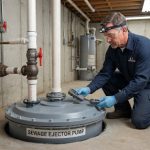
One of the most terrifying scenarios I encounter is when a property owner walks into a basement flooding emergency and finds their pump completely silent. No hum, no attempt to run, just dead. This often points to a power issue, a failed float switch, or a pump that has finally given out after years of service.
If your flooded basement pump is not responding, check the breaker first. If the pump trips breaker every time it tries to start, you likely have a ground fault or a seized motor. If the breaker is on but the pump is silent, the float switch may be stuck or the pump itself may have failed.
In these moments, I have seen people waste precious time trying to manually jiggle the float or reset the pump over and over while water continues to rise. If you have a backup pump, now is the time to make sure it is operational.
If you do not have a backup, you need to consider alternative methods like a utility pump, a wet dry vacuum, or in extreme cases, calling in a restoration company to start pumping while we work on repairing the primary system. A basement flooding emergency does not wait for you to figure things out, and neither should your response.
Listening To the Sounds of Sump Pump Failure Flooding
Maybe you are in the middle of a basement flooding emergency, and your pump is running, but the water is not going down. This is a different kind of nightmare. You can hear your pump making noise, you know it is trying, but something is preventing it from doing its job.
What you hear tells us what is wrong. If your pump making noise sounds like a loud hum or a grinding, you may have a clogged impeller. Debris like stones, mud, or even small toys can get sucked into the pump and jam the impeller, preventing it from moving water even though the motor is running.
If the pump making noise sounds like it is cycling on and off rapidly, you may have a failed check valve that is allowing water to flow back into the pit as fast as the pump can push it out. If the sound is a high pitched squeal, bearings inside the motor may be failing.
I have responded to countless sump pump failure flooding calls where the pump was running full speed but moving no water at all because the impeller had come loose from the shaft. That sound of a motor spinning freely without resistance is unmistakable once you have heard it.
In a basement flooding emergency, listening to what your pump is telling you can help you decide whether a quick fix is possible or if you need to abandon that pump and find another way to move water.
When Your Pump Doesn’t Know There Is a Problem
I cannot tell you how many times I have arrived at a basement flooding emergency only to find that the pump itself was perfectly fine. The problem was that the float switch never told it to turn on. Float switches get stuck. They get tangled in cords. They get weighed down by debris.
Sometimes they simply fail. In these situations, you may be standing in water while your pump sits in the pit, fully capable of pumping, but completely unaware that it is needed. If you are in a basement flooding emergency and you can see that the water level is above where the float should have activated, try gently moving the float to see if the pump kicks on.
Be careful, and if you are not comfortable reaching into the pit with water present, do not risk it. But if you can safely trigger the float and the pump starts, you have bought yourself time. The pump will run and lower the water, giving you a window to figure out why the float failed and whether you need a replacement.
This is a temporary solution at best. But in a basement flooding emergency, temporary solutions that stop the rising water are worth their weight in gold.
When Pump Alignment and Vibration Point to Bigger Problems
Sometimes the basement flooding emergency you are facing did not come out of nowhere. Looking back, you may realize that your pump had been giving you warning signs for weeks or months that you did not recognize. Maybe you had noticed pump vibration that seemed to be getting worse.
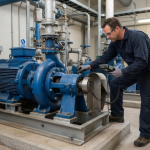
Maybe you had heard your pump making noise but dismissed it because the pump was still running. These are not small issues. Pump vibration and unusual noise are often the first signs of motor bearing failure or serious pump alignment problems. When motor bearing failure occurs, it can happen suddenly, leaving you with a seized pump in the middle of a storm.
When pump alignment is off, it puts stress on seals and couplings, leading to premature failure at the worst possible time. If you are dealing with a basement flooding emergency right now, and you realize in hindsight that your pump had been showing signs of pump vibration or pump alignment issues, you are not alone.
Many of the emergency calls we respond to could have been prevented with earlier attention to these symptoms. Once the immediate crisis is handled, we can talk about how proper pump vibration repair and alignment work could have prevented this situation and will prevent the next one.
Why Regular Maintenance Is Your Best Defense Against Emergency Pump Repair
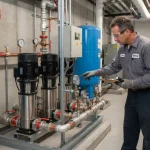
Let me be honest with you. Most of the basement flooding emergency calls I respond to are preventable. Not all, but most. A pump that is tested regularly, inspected for signs of wear, and maintained by professionals is far less likely to fail when you need it most.
Regular pump maintenance would have caught that failing float switch before it left you with a silent pump during a storm. It would have identified the pump making noise that signaled motor bearing failure was approaching. It would have detected pump vibration issues and addressed them before they caused a catastrophic breakdown.
When you wait until you are in a basement flooding emergency to think about your pump, you are already behind. You are in crisis mode, making decisions under pressure, paying emergency rates, and dealing with water damage that could have been avoided.
I know life is busy. I know there are a hundred things competing for your attention. But the cost of regular pump maintenance is nothing compared to the cost of a single sump pump failure flooding event. Nothing.
From Panic to Plan, Surviving Your Basement Flooding Emergency
I know that right now, if you are reading this because you are in the middle of a basement flooding emergency, your heart is racing. You are looking at water where water should never be, and you are trying to figure out how to make it stop. That feeling of helplessness is something I have seen in the eyes of so many property owners over the years.
But here is what I want you to remember. You are not helpless. You have a plan now. You know to check the power first. You know to listen to what your pump making noise is telling you. You know that a stuck float, a clogged impeller, or a failed check valve might be the culprit.
And you know that when the situation is beyond what you can handle, there is a team ready to help. Once the water is gone and your basement is dry, we need to talk about what comes next. We need to figure out why your pump failed and how to make sure it never happens again.
Because the best basement flooding emergency is the one that never happens. Let us help you get through this crisis and build a plan that keeps your basement dry for good.