You know that feeling when you’re driving and a strange noise starts coming from the engine, and you turn up the radio just to pretend it isn’t happening? We’ve all been there. It’s human nature to hope that if we ignore a problem long enough, it might just go away on its own.
But deep down, you know that little click or whine isn’t disappearing. It’s waiting. And in the world of industrial pumps, that waiting game is a dangerous one. I’ve stood next to facility managers who described the sound of a failing bearing as a “minor annoyance” just three days before their entire production line went dark.
The truth is, your pump motor talks to you all the time. It hums when it’s happy, it purrs when it’s cruising, and when something is wrong, it screams in a language of heat, vibration, and sound. The question is whether you’re listening.
For over four decades, we’ve been the ones called in when the silence finally breaks, and we’ve learned that the difference between a simple bearing replacement and a catastrophic shutdown is usually just a matter of catching the warning signs early. So, let’s turn down the radio for a minute and talk about what your motor has been trying to tell you.
How Pump Motor Bearing Failure Turns Bearings into The Weakest Link in Your System
Let’s get one thing straight right from the start. Bearings are the unsung heroes of your pumping operation. They sit there, day after day, year after year, carrying enormous loads, spinning at thousands of revolutions per minute, and asking for almost nothing in return.
They are the tiny rolling soldiers that keep your shaft centered, your rotor balanced, and your motor running smoothly. But here’s the hard truth. They don’t last forever. And when they start to go, they take the rest of the system with them.
Pump motor bearing failure isn’t usually a sudden event. It’s a slow decay. It starts microscopically, with tiny pits forming on the raceways or the balls themselves. Maybe it’s contamination from a failed seal letting grit in. Maybe it’s lubrication breakdown because someone missed a greasing interval. Maybe it’s just plain old fatigue after millions of miles of rotation.
Whatever the cause, the result is a cascade of destruction. A rough bearing creates friction. Friction creates heat. Heat breaks down lubricant. Broken lubricant accelerates wear. And before you know it, that tiny imperfection has turned into a seized bearing, a scored shaft, or a rotor that’s rubbing against the stator. Recognizing the bearing failure symptoms early is the only way to stop this domino effect before it topples your entire operation.
The Sound of Trouble: Listening for Motor Bearing Noise Before It’s Too Late
Close your eyes for a second. Imagine you’re walking through your facility, just doing your daily rounds. You pass by a pump that you’ve walked past a hundred times before. But today, something feels different. It’s subtle, but it’s there. Is that a faint whine you’re hearing?
A slight growl? Maybe a rhythmic clicking that wasn’t there last week? That, my friend, is your motor crying for help.
Motor bearing noise is often the very first warning sign that something is wrong, and it’s also the most ignored. We get it. Industrial environments are loud. There’s always some background noise, some vibration, some hum that you’ve learned to tune out. But motor bearing noise has a distinct character.
It’s often a high-pitched squeal or a low growl that changes with the speed of the motor. Sometimes it sounds like a grinding noise, like tiny rocks being crushed inside a metal can. In the early stages, it might only appear under load or during startup. As the damage progresses, the noise becomes constant and unmistakable.
Heat, Vibration, And Other Bearing Failure Symptoms You Can’t Afford to Ignore
Sound isn’t the only messenger. Your pump motor communicates through other channels too, and if you know what to look for, you can catch bearing failure symptoms long before they become catastrophic. These are the physical signs that something is wrong beneath the surface, and they often show up even before the noise becomes obvious.
Let’s talk about pump motor overheating first. Bearings generate heat naturally as they spin, but when they start to fail, friction skyrockets and so does the temperature. If you walk up to your motor and feel excessive heat radiating from the bearing housings, or if your infrared thermometer is showing numbers that are higher than usual, you’re looking at a bearing that’s fighting for its life.
Pump motor overheating isn’t just a symptom on its own. It accelerates lubricant breakdown, softens grease, and creates a feedback loop that makes the bearing fail faster. A hot bearing is a dying bearing, plain and simple. Then there’s the shaking. Pump vibration problems are another classic indicator that your bearings are in trouble.
A healthy bearing keeps the shaft rotating smoothly on its axis. A worn bearing lets the shaft wobble, even if it’s just by a few thousandths of an inch. That wobble translates into vibration that travels through the pump, the piping, and the foundation. Pump vibration problems aren’t just annoying.
Prevention Over Panic: Building A Pump Maintenance Schedule That Saves You Money
Here’s the part that hurts. Most pump motor bearing failure incidents are completely preventable. Not sometimes. Not usually. Almost always. And the tool that prevents them isn’t expensive. It’s consistency. It’s a solid pump maintenance schedule that you actually stick to, not just a binder on a shelf that collects dust.
A good pump maintenance schedule starts with lubrication. Bearings need the right grease, in the right amount, at the right intervals. Too little grease and they run dry. Too much grease and they overheat from fluid friction. The wrong grease and they break down prematurely.
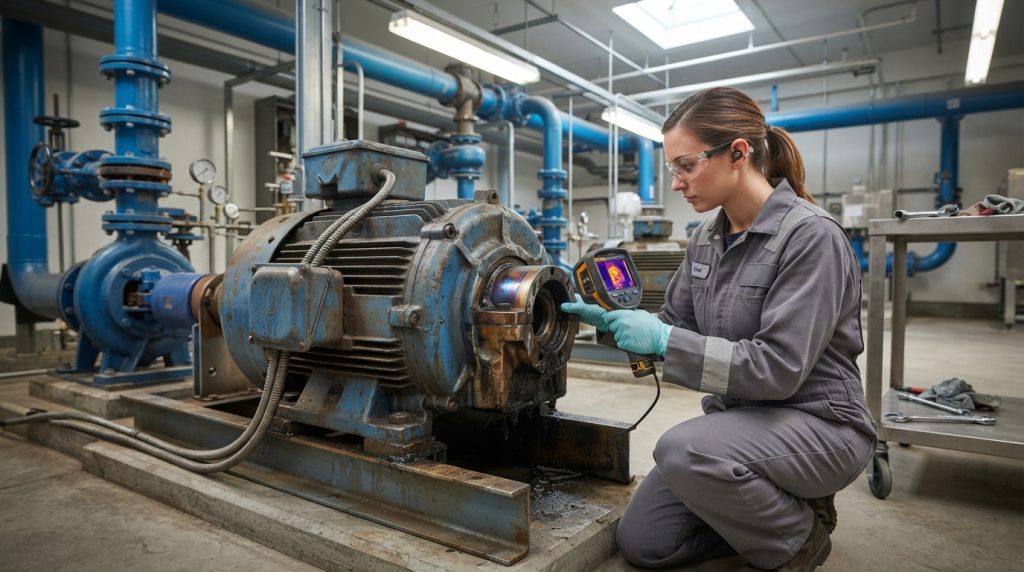
A maintenance schedule that tracks grease types, quantities, and relubrication intervals is your first line of defense. But lubrication is just the beginning. A robust pump maintenance schedule also includes regular vibration analysis to catch early imbalances. It includes thermography to spot hot spots before they become failures.
It includes oil analysis if your bearings are oil lubricated, checking for metal particles that signal wear. It includes alignment checks to ensure the motor and pump shafts are still perfectly lined up. And it includes a log of motor bearing noise observations so you can track changes over time.
When Failure Strikes: Why Professional Motor Bearing Service Is Worth Every Penny
Okay, let’s say the worst has happened. Despite your best efforts, you missed the signs, or maybe the bearing just reached the end of its natural life. Now you’re standing in front of a motor that sounds like a bag of rocks, and you need to make a decision. Do you have your in-house team pull it apart, or do you call in the specialists?
We’ve seen both scenarios play out, and we’ll be honest with you. Bearing replacement looks simple on paper. Remove the old bearings, press on the new ones, put it back together. But there’s a reason we’ve spent forty years mastering this craft. Improper installation is one of the leading causes of premature bearing failure.
If you press a bearing onto a shaft incorrectly, you can damage the internal clearances without even knowing it. If you don’t use the right induction heater or the proper press fit, you create micro cracks that will fail six months down the road. If you don’t check the shaft for scoring or the housing for wear, you’re putting new bearings into a damaged home.
That’s where professional motor bearing service comes in. A qualified motor bearing service team brings more than just tools. They bring experience. They bring precision measurement instruments to check shaft diameters and housing bores.
Why Catching Pump Motor Bearing Failure Early Changes Everything
You’ve read the signs, you understand the stakes, and now you have a choice to make. You can keep walking past that pump, turning up the mental radio, hoping that weird noise is nothing. Or you can listen. You can take action. You can be the one who catches bearing failure symptoms early and turns what could have been a disaster into a routine maintenance note.
We’ve been in this business for over forty years, and we’ve seen the relief in a facility manager’s eyes when we tell them we caught a failing bearing just in time. We’ve also seen the weight on their shoulders when we show up to a seized motor that should have been fixed months ago.
You don’t have to navigate this alone. Whether you’re dealing with pump motor overheating issues, chasing down pump vibration problems, building a reliable pump maintenance schedule, or need expert motor bearing service, we’re here to help.
Let’s keep your motors running, your production flowing, and your peace of mind intact. Give us a call. Your pump has been trying to tell you something. Let’s listen together.