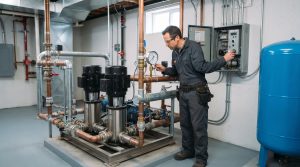
You walk into your building’s mechanical room, flip the switch, and… nothing. Just silence where there should be the familiar hum of your pump system working hard to keep everything moving. If you are reading this, chances are you are dealing with that exact sinking feeling.
I know that moment all too well, and I know the pressure that follows. Whether you are managing a commercial high rise in Manhattan or overseeing a critical industrial facility in Brooklyn, a pump motor won’t start is more than an inconvenience, it is a stop sign for your entire operation.
As the team recognized throughout NYC and NY as the #1 pump repair company, we have seen these situations cause panic more times than we can count. But before you let the stress take over, take a breath. We are going to walk through this together.
Most startup failures are fixable without a complete overhaul, and with a little guidance, you might just get things moving again. Let’s figure out why your motor is not starting and get you back to business.
Why Your Pump Motor Won’t Start: Understanding the Root Causes
When a pump motor won’t start, it is easy to assume the worst. Our minds go straight to catastrophic failure, costly replacements, and long downtimes. But in my years of experience handling pump repair across New York, New Jersey, and Pennsylvania, I can tell you that the culprit is often something far simpler. We need to approach this like detectives.
What changed between the last time the system ran and now? Was there a storm? Did someone perform maintenance recently? The goal here is to work through the possibilities logically, eliminating the simple stuff before we dive into the complex components.
This is where experience pays off. A seasoned technician knows that a motor not starting is often a symptom, not the disease itself. We are going to look at the power supply, the controls, the mechanical side, and the safety features.
By the end of this checklist, you will have a roadmap to either solve the problem yourself or know exactly what to tell a professional when you call for help.
Check The Power Source First: When Your Pump Trips Breaker or Won’t Draw Power
Let’s start with the absolute basics. I cannot tell you how many service calls I have been on where we drove across NYC only to find a disconnect switch in the off position or a breaker that simply needed to be reset. It happens to the best of us, especially in busy facilities where multiple people might be working on different equipment.
First, verify that the disconnect switch at the pump location is in the “on” position. Next, head to your electrical panel. If you find that your pump trips breaker immediately when you try to start it, that is a huge clue. A breaker that trips instantly usually indicates a short circuit or a severe ground fault.
However, if the breaker holds, but the motor still won’t run, you might be dealing with a different issue. Take a moment to check for blown fuses if your system uses them. A simple continuity test with a multimeter will tell you if the fuses are intact.
Remember, safety first. If you are not comfortable working around live electrical components, stop right here and call a professional. But if you are equipped and careful, confirming that power is actually reaching the motor is the necessary first step in solving why your pump won’t run.
Decoding The Sounds of a Motor That Won’t Start
Your ears are one of the best diagnostic tools you have. When you attempt to start the system, what do you hear? Does it hum loudly but refuse to turn? Does it click and then go silent? Or is there just dead silence? A humming sound typically means power is reaching the motor, but the motor is locked up or cannot overcome the load.
This could be a mechanical bind in the pump itself, like a seized bearing or a foreign object lodged in the impeller. If you hear a rapid clicking sound, that often points to a contactor issue or low voltage where the magnetic coil is chattering because it is not getting enough power to hold itself closed.
And if you hear nothing at all, we go back to the power supply or a failed control component. These sounds are the language your equipment uses to tell you what is wrong. When dealing with motor startup problems, the difference between a hum, a click, and silence can save you hours of troubleshooting time. Pay attention to what your system is trying to tell you.
Motor Overheating and Thermal Overload Protection
One of the most common reasons a pump motor won’t start is actually a safety feature doing its job. Motors have built in thermal overload protection designed to shut the motor down before it destroys itself. If your motor has been running hard, perhaps during an unusually hot day or under a heavy load, it may have overheated and tripped this internal switch.
This is where motor overheating becomes a primary suspect. Sometimes, the overload is external, located in the starter enclosure with a reset button. Other times, it is embedded in the motor windings and requires the motor to cool down before it will automatically reset. If you suspect motor overheating, let the motor cool for an hour or two and try again. However, if it starts up again only to shut down once more, you have a recurring problem.
This could be due to a failing motor, a pump that is running too hard, or poor ventilation around the motor itself. Frequent motor overheating is a red flag that should not be ignored. It is the motor crying out for help before it burns up completely.
Diving Into the Controls: VFD Troubleshooting for Modern Systems
In many commercial and industrial settings these days, your pump is likely controlled by a Variable Frequency Drive, or VFD. These devices are incredible for energy savings and precise control, but they add a layer of complexity when your motor is not starting. If you have a VFD in your system and your pump won’t run, your first step should be to look at the display screen on the drive.
That little screen holds the answers. Most VFDs will display a fault code that tells you exactly why it decided to shut down. It could be a phase loss, an overcurrent condition, or a communication error. This is where proper VFD troubleshooting comes into play. Do not just cycle the power and hope the error goes away.
That is like clearing a check engine light without reading the code. You need to document the fault code, look it up in the manufacturer’s manual, and understand what triggered it. VFD troubleshooting often involves checking parameters, inspecting the keypad for damage, and ensuring that the drive is receiving the correct start signal from your building management system or pressure switches.
If you are not comfortable navigating VFD menus, this is one area where professional motor repair service can save you from accidentally damaging an expensive drive.
When The Motor Is Trying but The Pump Won’t Move
Sometimes, the electrical side is working perfectly, but the mechanical side is holding everything hostage. If your motor is not starting but you can hear it trying to hum, the problem might be that the pump is physically seized. Over time, seals wear out, bearings dry up, and debris finds its way into the volute.
If the pump has been sitting idle for a while, the internal components can rust together, creating a lock that the motor simply cannot overcome. In these cases, trying to force the motor to start can lead to burnout. You need to isolate the motor from the pump if possible. By loosening the coupling or removing the belt, you can determine if the motor spins freely on its own.
If the motor runs fine without the pump attached, you have isolated the issue to the pump itself. If the motor still hums and refuses to spin even when disconnected, the motor bearings may be seized. This mechanical detective work is essential in diagnosing why a pump won’t run efficiently and safely.
When To Call the Experts: Knowing Your Limits with Motor Repair Service
I am a huge believer in empowering facility managers and building owners to handle the small stuff. Resetting a breaker, checking a disconnect switch, or even resetting a thermal overload are all within the realm of a capable onsite team. But there comes a point where you need to put your hands up and call in the pros.
If you have gone through this checklist, you have verified power, reset breakers, let the motor cool, checked for mechanical binds, and even looked at VFD fault codes, yet your pump motor won’t start, it is time to reach out for a motor repair service. Attempting to tear into a motor yourself without the proper tools and experience can turn a repairable issue into a catastrophic failure.
As the leading experts in pump repair across NYC, NY, NJ, and PA, we have seen well intentioned attempts go wrong. When you need a motor repair service, you want a team that understands the specific demands of commercial and industrial applications in our region.
We treat every call with the urgency it deserves because we know that when your pumps are down, your operations are at a standstill.
Turning A Frustrating Situation into a Solved Problem
Dealing with a pump that refuses to start is never a fun way to spend your day. I understand the weight that comes with responsibility for critical systems, the anxiety of watching the clock tick by while your operations are compromised. But moments like these are also a reminder of why having a clear, logical approach matters.
By working through the basics of power supply, listening to the sounds your equipment makes, respecting the signs of motor overheating, and understanding the nuances of VFD troubleshooting, you put yourself in control of the situation. You move from panic to problem solving.
And when the issue exceeds what can be safely handled in house, you now know that the right motor repair service is just a phone call away. As the team recognized throughout NYC and NY as the #1 pump repair company, our dedicated team ensures dependable and efficient solutions while maintaining the highest standards in the industry.
We serve and operate in NY, NJ, and PA, ready to step in when you need us most. Do not let a stubborn pump ruin your day. Use this checklist, trust your instincts, and remember that getting back to the steady hum of a working system is always the goal.