Have you ever walked into a room and just felt the tension in the air? Maybe it was before a storm, or during a difficult conversation where you knew one wrong word could change everything. Now, imagine working in a space where that tension isn’t just emotional, it’s physical.
Where the air itself holds a hidden danger, and the slightest spark could turn a Tuesday afternoon into a headline. For so many of you working in refineries, chemical plants, or maritime environments, that invisible tension is just another day on the job. You know the risks.
You’ve done the safety drills. But here’s the question that keeps facility managers and safety officers up at night: is every piece of equipment on your site doing its part to keep that spark from flying? When it comes to the motors driving your pumps, the stakes couldn’t be higher.
Choosing the wrong motor isn’t just a performance issue; it’s a life safety issue. That’s why understanding when explosion proof needed isn’t just regulatory jargon, it’s the line between controlled power and uncontrolled disaster.
We’ve spent over four decades standing in those hazardous environments with you, and today, we’re going to talk about how to breathe easier in rooms where the air itself can’t.
Why Your Hazardous Location Motor Choice Matters
Let’s paint a picture. You’re on site, and there’s a faint smell in the air. Maybe it’s gas, maybe it’s a solvent, maybe it’s dust from a grain elevator. To your nose, it’s just a smell. To a standard electric motor, it’s fuel. You see, every motor, no matter how well built, creates tiny sparks inside.
It happens when the brushes commutate, when contacts open and close, or even just from static buildup. In a normal environment, those sparks live and die inside the motor housing without anyone ever knowing. But if that motor is sitting in a classified area pump room where flammable vapors or combustible dusts are present, that hidden spark becomes a detonator.
The danger isn’t just the fuel; it’s the ignorance of ignoring the environment. We’re talking about hazardous location motor requirements for a reason. These aren’t bureaucratic checkboxes. They are engineering responses to very real physics. In a Class I environment, for example, you might have gases like hydrogen or propane floating around.
These gases need just two things to ignite: oxygen and an ignition source. Your standard motor provides the ignition source for free. The only thing standing between you and a potential explosion is the integrity of the equipment you choose.
Understanding the specific classification of your site, whether it’s Division 1 where hazards exist under normal conditions, or Division 2 where they only exist under abnormal conditions is the first step in understanding why a heavy, sealed, rugged motor isn’t a luxury; it’s a necessity.
How does an Explosion Proof Motor Actually Work?
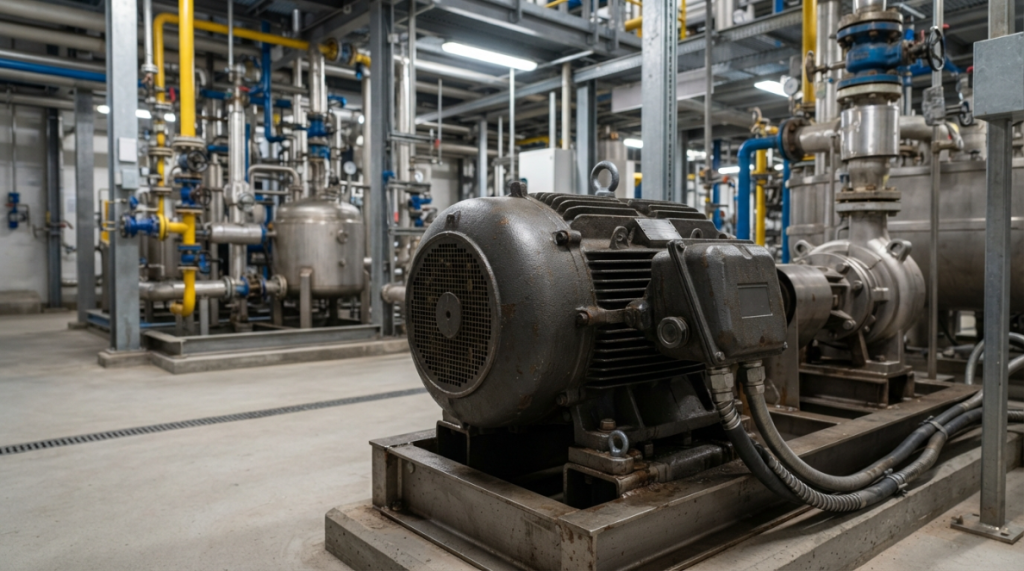
Okay, let’s clear up the biggest misconception right now. When we talk about an explosion proof motor, people often think it means the motor itself is indestructible, that it can survive a bomb going off inside it. That’s not quite right. The genius of an explosion proof motor isn’t that it keeps explosions out; it’s that it contains them if they happen inside.
Think of it like a high security vault. If a robber sets off a bomb inside the vault, the vault is designed to contain that blast so the rest of the bank doesn’t collapse. That’s exactly what these motors do. The housing is thick, the bolts are heavy, and the joints where the end bells meet the frame are precision machined to be flame paths.
If flammable gases seep into the motor and ignite, the housing is strong enough to withstand the internal pressure. More importantly, the gaps are so carefully engineered that the hot expanding gases cool down as they escape, dropping below the ignition temperature of the outside atmosphere. It contains the fire so the fire doesn’t find the fuel.
That level of engineering is why proper motor selection in these environments is a matter of life and death, not just efficiency.
Navigating TEFC Vs ODP and Other Pump Motor Types
So you’re standing in front of a catalog or talking to a supplier, and suddenly you’re hit with a wall of acronyms. ODP. TEFC. XP. It’s enough to make your head spin. But understanding the difference between these pump motor types is how you match the tool to the task safely.
You might be familiar with an ODP, or Open Drip Proof motor. These guys have vents that allow air to circulate through the windings to keep them cool. They are great for clean, dry, indoor spaces. But put an ODP in a dusty grain silo or near a chemical vapor, and you’re basically inviting disaster.
The air that cools the motor also carries the explosive dust or gas directly over the electrical components. That’s a recipe for tragedy. On the other hand, you have the workhorse of many industrial sites: the TEFC motor. TEFC vs ODP is a classic debate, but for hazardous locations, the choice often becomes clear.
A TEFC motor, or Totally Enclosed Fan Cooled motor, doesn’t rely on outside air to cool the windings. Instead, it has a closed frame and uses an external fan to blow air over the outside of the case. This design keeps the dangerous atmosphere separate from the internal sparks, making it the baseline for safety.
However, even a standard TEFC isn’t enough for the most severe environments. That’s where you step up to the specifically rated explosion proof motor, which takes the TEFC enclosure and adds the heavy duty flameproof housing we talked about earlier. Knowing which league you’re playing in is critical.
Pinpointing Exactly When Explosion Proof Is Needed
This is the million-dollar question that keeps safety audits honest: when explosion proof needed? The answer isn’t a universal “always,” but it’s closer to “more often than you think.” The trigger isn’t the type of industry you’re in; it’s the specific chemistry of your environment.
If your facility handles any substance that can become volatile, think petroleum products, solvents, alcohols, natural gas, or even something as seemingly harmless as grain dust or sugar dust, you need to pull out the National Electrical Code (NEC) and start reading.
Specifically, you’re looking at Article 500. The code breaks down hazardous locations into Classes and Divisions. Class I is gases and vapors, Class II is combustible dusts, and Class III is ignitable fibers. If your classified area pump sits in a Class I, Division 1 location, meaning the hazard is present during normal operation, you absolutely require a motor rated for that zone. There is no wiggle room.
But here’s where it gets tricky. Even if your operation is normally safe, you might have areas designated as Division 2, where the hazard only appears during accidents or maintenance failures. In many Division 2 locations, a standard TEFC motor might be acceptable, but it’s a decision that requires deep expertise.
You have to consider the auto ignition temperature of the materials present, the potential for spills, and the ventilation of the space. Guessing here is not an option. This is where relying on a qualified motor selection partner becomes your best safety net.
More Than Just a Motor: The Maintenance Mindset for Maximum Safety
Buying the right motor is a huge step, but it’s not the finish line. Imagine installing a state of the art security system in your house and then leaving the front door wide open. That’s what it feels like when a properly rated explosion proof motor isn’t maintained correctly.
Over time, bolts can loosen. Gaskets can dry out and crack. Conduit seals can degrade. If the flameproof path is compromised, the motor loses its ability to contain an internal ignition.
This is why regular, professional care is non-negotiable. You need a partner who understands the gravity of what’s at stake. Seeking out a specialized explosion proof motor service provider ensures that when we open up that motor for inspection or repair, we put it back together to the exacting standards it requires.
We check the flame paths, we replace any compromised seals, and we verify the integrity of the thermal protection. A good explosion proof motor service doesn’t just fix what’s broken; it preserves the safety bubble that allows your facility to operate without fear. It’s the difference between owning safety equipment and actually maintaining a safe operation.
When Your Safety Depends on The Right Explosion Proof Motor
So, when are explosion proof pump motors required? They are required the moment you accept that the air around you isn’t just empty space; it’s a potential fuel source waiting for a match. They are required when you look at the faces of your team, your family, or your community and decide that no financial consideration is worth their safety.
Navigating the world of hazardous location motor rules and classified area pump designations can feel overwhelming, I know. But you don’t have to walk that tightrope alone. With four decades of standing beside you in the field, our team knows the difference between a motor that runs and a motor that protects.
Whether you need help deciding between TEFC vs ODP housings, selecting the right fit from the many pump motor types, or scheduling a rigorous inspection through our explosion proof motor service, we are here.
Let’s make sure the only thing igniting in your facility tomorrow is progress. Give us a call and let’s secure your peace of mind together.