You head down to your basement on a rainy Tuesday morning, maybe to grab something from storage or do a load of laundry, and you step into a puddle. Your heart sinks. You look around and see water creeping across the floor, soaking into boxes, threatening everything you have stored down there. Panic sets in.
Is it a broken pipe? Is it groundwater? Is it something worse? In that moment, most people just want the water gone. They do not care how it happens, they just want it out. But here is the truth that 80 years in this business has taught us. What is causing that water, and more importantly, what kind of water it is, determines everything about how you fix it.
You cannot just slap any pump in there and hope for the best. That is why understanding the difference between a sewage ejector vs sump pump is not just plumbing nerd talk. It is the difference between protecting your home and creating a massive health hazard.
Across NY, NJ, and PA, we have walked into too many basements where someone installed the wrong pump, and the results were always disastrous. Today, I am going to help you understand these two heroes of the basement so you never make that mistake.
What Exactly Sets a Sewage Ejector Vs Sump Pump Apart
If you only take one thing away from this entire article, let it be this. A sump pump deals with clear water. A sewage ejector pump deals with everything else. When we talk about the sewage ejector vs sump pump debate, we are really talking about what each machine is designed to handle.
- A sump pump sits in a pit at your basement’s lowest point, collecting groundwater that seeps through the foundation and pumping it safely outside. That water is relatively clean — maybe some silt, but not dangerous.
- A sewage ejector pump lives in a sealed basin connected to your basement bathroom, laundry, or kitchen. It handles wastewater from toilets, sinks, and washing machines — pumping it uphill through solids and all into the main sewer line.
Mixing these two up, like using a sump pump to handle sewage, guarantees a clogged, broken, and horrifically messy failure. Understanding this fundamental ejector pump difference is the first step toward a dry and sanitary basement.
Your Basement’s First Line of Defense Against Mother Nature and Why It Is Not a Sewage Ejector Vs Sump Pump Debate
Let us talk about the unsung hero that keeps millions of basements dry across New York and New Jersey. A sump pump is a relatively simple machine with a critically important job. When rain saturates the ground around your foundation, hydrostatic pressure builds up and forces water through the smallest cracks in your basement floor or walls.
- That collected groundwater sits in the sump pit until it hits a set level — then a float switch triggers the pump, which pushes the water out through a discharge pipe and away from your foundation before any damage is done.
- It is a beautifully simple system — when it handles what it was designed for. The critical thing to understand about basement pump types is that a sump pump is only built for clear water. Send solids through it and it will clog almost instantly.
That is why when your sump pump not working becomes a reality, the first question we always ask is what kind of water ended up in that pit.
The Sewage Ejector Pump Story: Handling the Mess You Do Not Want to Think About
Now let us talk about the other side of the coin. If your basement is finished and includes a bathroom, a laundry room, or a kitchen, you have a challenge. Those fixtures sit below the level of the main sewer line leaving your house, which means gravity cannot do its job.
Everything you flush or wash down the drain needs to be pushed uphill to reach the sewer. That is where a sewage ejector vs sump pump comparison gets real. A sewage ejector pump is built like a tank for a reason. It sits in a sealed basin that collects all the wastewater from your basement fixtures.
- When the sealed basin fills, the ejector pump kicks on and does something a sump pump never could — it pushes solids through. Toilet paper, waste, and whatever else ends up in there passes through larger passages and a more powerful motor built specifically for this abuse.
If you have ever wondered about the grinder pump vs ejector question, here is the quick version. An ejector pump pushes solids through with raw power, while a grinder pump actually cuts everything into a fine slurry before pumping. Both handle sewage, just in different ways.
Why Confusing These Two Can Lead to A Nightmare You Will Never Forget
I need to be really honest with you here. Over 80 years, we have seen some things. We have been called to basements where someone installed a regular sump pump in a sewage basin because they were trying to save a few hundred dollars. The results were always, always bad.
- A sump pump trying to handle sewage clogs immediately — solids block the small intake, the motor burns out fighting the blockage, and the basin overflows. What was a manageable problem becomes raw sewage spreading across your finished basement floor.
- The smell is unforgettable. The health risks are real. The cleanup costs are astronomical. That is why understanding the sewage pump vs sump distinction is not just academic — it is about protecting your family, your property, and your sanity.
A sewage ejector vs sump pump mix up is one of the most expensive mistakes you can make in your home, and it is completely avoidable with a little knowledge.
How To Identify Which Pump You Actually Have
Maybe you moved into a house with an existing system, or maybe you are troubleshooting a problem and you are not sure what you are looking at. Let me help you figure out which basement pump types you are dealing with. Start with the lid.
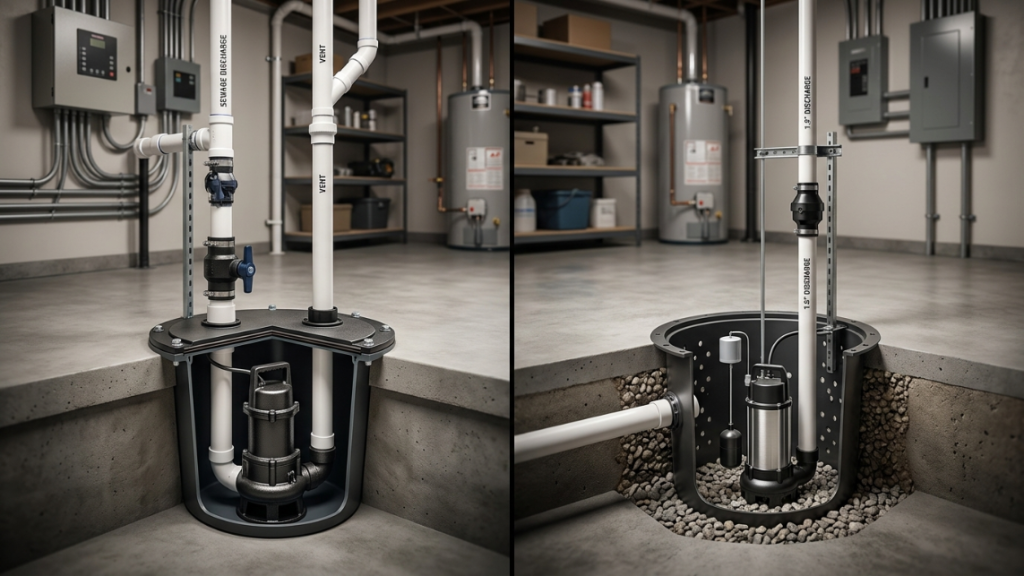
- Check the lid first. A sump pump pit usually has a loose or partially sealed cover — groundwater does not require a seal. A sewage ejector basin always has an airtight sealed lid. This is non-negotiable; it keeps sewer gases out of your living space.
- Next, check the pipes. A sump pump has a single discharge pipe running out through the wall. A sewage ejector system has a larger four-inch pipe plus vent pipes running up through the roof to safely release sewer gas.
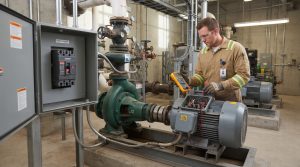
And finally, look for the sewage ejector pump alarm. This is a dead giveaway. Most sewage systems include an alarm box mounted on the wall that sounds if the water level gets too high, warning you of a problem before sewage floods your basement.
What To Do When Your Sump Pump Not Working Leaves You Standing in Water
It happens to the best of us. A big storm rolls through, the power flickers, or a pump that has been running for years finally gives up, and suddenly you have water creeping across your basement floor. When your sump pump not working becomes your new reality, you need to act fast, but you also need to act smart.
- If the water looks clear, try lifting the float switch manually — sometimes it just gets stuck and a nudge is enough to get the pump running again. Also check the basics: is it plugged in? Did the circuit breaker trip? These simple checks resolve more failures than you would think.
If you have a backup system, now is the time to thank your past self for installing it. But here is the critical warning. If that water is not clear, if it smells bad or came from a backed up drain, do not go sticking your hands in it. That is sewage, and it is full of bacteria and pathogens. In that situation, you need to evacuate the area and call for professional sewage ejector pump service immediately.
Knowing The Difference Between Sewage Ejector Vs Sump Pump Saves Your Basement from Disaster
Standing in a basement full of water is one of the most helpless feelings in the world. Whether that water is clear groundwater seeping through a crack or something far worse backing up from a failed ejector, the panic is real. But knowledge is power.
- You now know that one handles the rain and the other handles the drain. You know mixing them up causes disaster. You know why that wall-mounted alarm cannot be ignored — and what it means when it goes off.
You understand the grinder pump vs ejector distinction and why professional installation matters. Armed with this knowledge, you can make smart decisions about your basement, your pumps, and your peace of mind. And when things go wrong, because they eventually do with mechanical equipment, you know who to call.