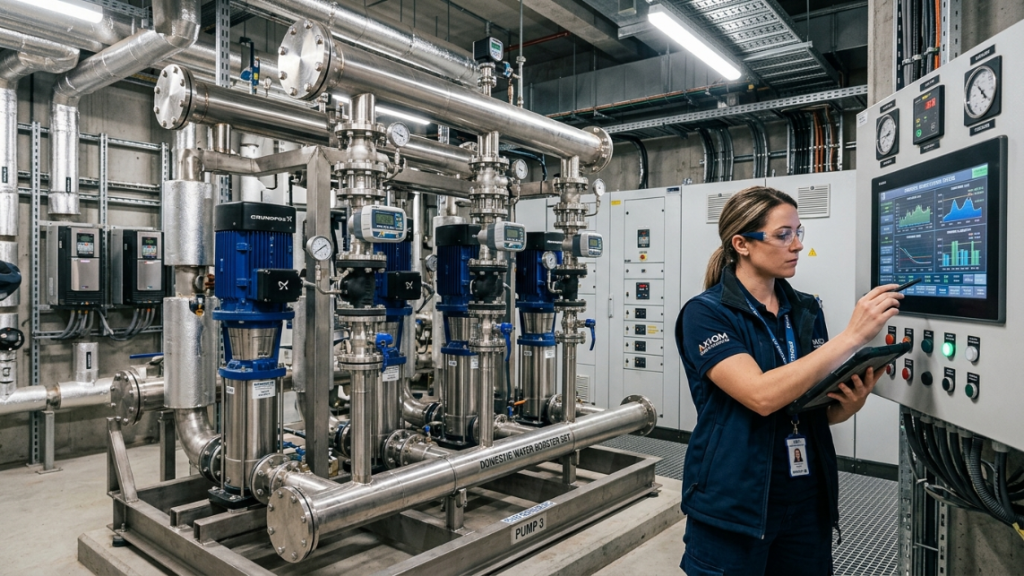
You have just finished constructing a beautiful new apartment building in Queens, or maybe you are renovating an old office space in Philadelphia. The tiles are laid, the paint is dry, and the tenants are ready to move in.
But then, on the final walkthrough, you turn on the faucet on the top floor and nothing happens. Well, a few sad drops happen, but nothing close to actual water pressure. The culprit? An improperly sized pump. This scenario plays out more often than you might think across NY, NJ, and PA, and it breaks my heart every single time.
After 80 years in the business, our team has seen it all. We have walked into too many buildings where someone guessed on the pump size, and the result was either weak water pressure or a system that burned out within a year. Getting the water booster pump sizing right is not just a technical detail.
It is the difference between a building that feels like home and one that feels like a constant battle. It is about peace of mind, reliable operations, and protecting your investment. Today, I am going to walk you through exactly how to get it right, drawing on the hard earned lessons from eight decades of serving New York and beyond.
Why Getting Your Water Booster Pump Sizing Right the First Time Saves You from Future Headaches?
Let me tell you something we have learned the hard way over the past 80 years. Water booster pump sizing is not a guessing game. It is not something you can eyeball or approximate based on what the building down the street used. When sizing is done incorrectly, the consequences follow you for the lifetime of the system.
- Size too small and the pump runs nonstop, burning out motors and spiking electricity bills. Size too big and you get short cycling — the pump hammers on and off rapidly, stressing pipes and causing premature failure. Both mistakes cost you money and sleepless nights.
That is why we treat every booster pump calculation like we are designing for our own mother’s building. We take the time, we do the math, and we make sure that when that pump kicks on, it delivers exactly what the building needs without breaking a sweat.
Understanding Flow Rate Calculation for Your Specific Building
Before you can even think about picking a pump out of a catalog, you have to understand the demand. This all starts with a proper flow rate calculation. Now, do not let that term intimidate you. It sounds like something out of an engineering textbook, but really, it is just a fancy way of asking one simple question: how much water does your building need at its busiest moment?
- Picture 7:30 AM in a residential high-rise: every tenant is simultaneously showering, flushing, running dishwashers, and brushing teeth. That is your peak moment, and your pump has to handle every gallon of it without missing a beat.
- Every toilet, sink, shower, and appliance gets assigned a fixture unit value per plumbing code. Add them up, apply demand factors, and you arrive at a gallons-per-minute number — the foundation your entire sizing decision rests on.
That number, measured in gallons per minute, becomes the foundation of your entire pump sizing guide. Miss this step, and nothing else matters. You are building on quicksand.
Pressure Is Not Just About Force, It Is About Reaching the Top Floor Every Single Time
Once you know how much water you need, you have to figure out how hard that water needs to push. This is where pressure comes into play, and it is the part of water booster pump sizing that trips up even experienced facility managers. You see, pressure has two jobs.
- Pressure has two jobs: it must overcome gravity to push water from the basement all the way to the highest fixture, and it must still arrive at that top floor with enough force that tenants get real water flow — not just a trickle.
- We measure the vertical height from pump to the highest outlet, convert that to pressure, then add residual pressure (typically 20–30 PSI) to ensure solid performance — not just bare minimum delivery.
This total pressure requirement, combined with your flow rate calculation, gives you what engineers call the duty point. That duty point is your target; the sweet spot your pump needs to hit.
The Hidden Factor Everyone Forgets: Accounting for Friction Loss in Your Piping
Here is something that does not get talked about enough in casual conversations about booster pump calculation. Your pipes are not perfectly smooth highways for water to travel through. They have friction. Every elbow, every valve, every foot of pipe creates resistance that eats away at your pressure.
- Think of it like running through a crowd — the further you go and the more turns you take, the slower you move. Every elbow, valve, and foot of pipe bleeds pressure, and ignoring friction loss is one of the most common errors in DIY pump sizing guide
- Pipe size, material, and run length all compound the loss — old galvanized steel with years of buildup can eat 20–30% of your calculated pressure before the water gets halfway to the top floor.
A proper water booster pump sizing process always accounts for this, ensuring that what leaves the pump is strong enough to arrive at the tap with authority.
Single Pump or Multiple Pumps: Navigating the Simplex Duplex Triplex Comparison
Now we get to one of the most important strategic decisions you will make. Do you install one big pump, or do you go with a system of multiple pumps working together? This is where understanding the simplex duplex triplex comparison becomes absolutely vital.
- A simplex system — one pump, lower upfront cost, fine for smaller buildings — has a critical flaw: if that single pump fails, you have zero water until it is repaired. For any commercial property, that is an unacceptable risk.
- A duplex system alternates two pumps — one handles regular demand while the other rests, the second kicks in for spikes, and if one fails the other keeps your building running. A triplex system extends this further, adding a third layer of redundancy and capacity for the largest facilities.
In our experience across NY, NJ, and PA, the extra investment in a duplex or triplex system pays for itself the first time a pump motor fails on a Friday night and your tenants never even notice because the backup kicked in seamlessly.
Matching Horsepower to Demand Without Wasting Energy or Money
Selecting the right motor size is where water booster pump sizing meets real world economics. Put a motor that is too small, and it burns out trying to keep up. Put a motor that is too large, and you are paying to spin extra mass you do not need, wasting electricity every single day.
- The sweet spot is matching motor horsepower precisely to the duty point calculated earlier. That is where VFDs come in — variable frequency drives have completely changed the economics of pump operation.
- Instead of running at full speed around the clock, a VFD-equipped pump ramps up to meet the morning rush and barely spins at 3 AM — saving significant energy and dramatically extending equipment life.
This kind of intelligent control saves enormous amounts of energy and dramatically extends the life of your equipment. When you are working through your booster pump calculation, ask your provider about VFD options. It is one of the best investments you can make.
Why Pump Size Means Nothing Without Proper Water Booster Installation
You can have the most perfectly sized pump in the world, with the most advanced VFD and the most efficient motor, but if the water booster installation is botched, none of it matters. I cannot tell you how many times we have been called to fix a system that was supposedly brand new, only to find that it was installed by someone who did not understand the unique challenges of high rise buildings in dense urban environments.
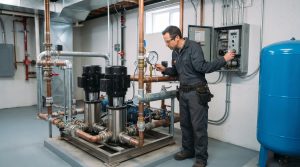
- Proper installation means anchoring the pump to prevent vibration transmission, fitting isolation valves so servicing never requires draining the whole building, positioning the expansion tank correctly, and setting pre-charge pressure accurately.
It means testing every connection, every wire, and every setting before walking away. A successful installation is invisible. It just works, day after day, year after year. And that is exactly what we have been delivering to our customers for eight decades.
Preparing For the Day Your Pump Motor Won’t Start
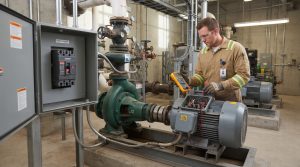
Even with perfect water booster pump sizing and flawless installation, mechanical equipment eventually has issues. That is just the reality of moving parts and electrical components. The day will likely come when your pump motor won’t start. Maybe it is a tripped breaker.
- A failed capacitor, corroded pressure switch, or tripped breaker can all silence your pump. In a correctly designed duplex or triplex system, you may never even notice — the backup simply takes over while the issue is resolved.
- If instead you are standing in a flooded mechanical room with no water to the building, you will understand exactly why we preach redundancy and expert installation so passionately — the alternative is not worth experiencing.
The best way to handle a motor failure is to have a system that keeps running despite it, and a trusted partner who can be there quickly to make the repair. That is the level of service we have built our reputation on across New York and beyond.
How To Tell If Your Current Pump Sizing Is Wrong
Maybe you are reading this guide because you already have a pump, and something feels off. Perhaps your tenants complain about pressure fluctuations. Maybe your electricity bills seem too high. These are signs that your existing water booster pump sizing might be off the mark.
- Constant cycling at low usage = oversized. Running non-stop without reaching pressure = undersized. Loud banging when the pump shuts off = water hammer from a pump too powerful for the system. Each symptom is a clear diagnostic signal.
- Do not ignore these warnings. The ongoing cost of energy waste, repair bills, and frustrated tenants from a wrong-sized pump almost always exceeds the one-time cost of replacing it with a correctly sized system.
Our team has helped countless building owners across NJ and PA make that transition, and the relief on their faces when the new system runs smoothly is something I never get tired of seeing.
Your Complete Water Booster Pump Guide: Bringing It All Together for Lasting Success
If you have made it this far, you now understand that water booster pump sizing is both an art and a science. It starts with a careful flow rate calculation to determine how much water your building demands at peak times. It requires an accurate assessment of the pressure needed to reach the highest floor while overcoming friction loss in the pipes.
It involves a strategic decision about whether a simplex, duplex, or triplex configuration makes the most sense for your specific situation, guided by a thorough understanding of the simplex duplex triplex comparison. It demands proper motor selection, ideally with variable speed technology, and it absolutely requires professional water booster installation to ensure everything works as intended.
This entire pump sizing guide is designed to give you the knowledge you need to make informed decisions, whether you are building new or upgrading an existing system. We have spent 80 years perfecting this process, and we are proud to be recognized as the #1 pump repair company in NYC because we take this responsibility seriously.