Imagine this: you are standing in the shower after a long day, ready to wash away the stress, but instead of a powerful, relaxing spray, you are greeted by a sad, trickling drizzle. Or perhaps you are a facility manager in a high rise downtown, and the tenants on the top floors are flooding your office with complaints about sinks that barely dribble.
If this scene feels all too familiar, you are likely dealing with water booster pump problems. For over 80 years, our family has been the go to experts for this exact scenario across NYC, NY, NJ, and PA. We know that when your water pressure vanishes, it is not just an inconvenience; it disrupts your entire day or your entire business.
A water booster pump is the unsung hero of any multi story building, designed to take that weak municipal supply and turn it into a force strong enough to reach the 20th floor. But like any hardworking hero, it can run into trouble. Whether you are dealing with a residential unit or a massive industrial complex, a faulty pump can bring operations to a screeching halt.
That is why we have put together this guide. We want to help you understand what is happening with your system, and more importantly, when it is time to call in the #1 water booster pump repair team in NY to get things flowing again.
What Exactly Is a Water Booster Pump and Why Should You Care About Its Potential Problems?
Before we dive into the nitty gritty of troubleshooting, let’s make sure we are all on the same page about what is a water booster pump. Think of your building’s water supply like blood flowing through veins. The municipal main has pressure, sure, but by the time that water fights gravity to reach the upper floors of a Brooklyn high rise or a sprawling commercial complex in NJ, the pressure is often lost.
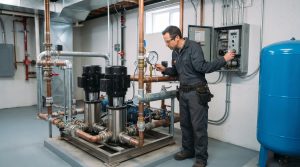
A water booster pump is essentially a mechanical heart that re pressurizes the water, pushing it upwards and outwards with enough force to give you that satisfying shower pressure. It takes the incoming flow and gives it the extra “oomph” it needs to satisfy the demands of your entire property. Without it, upper floors are left high and dry.
It is a critical piece of equipment that we have specialized in for decades, ensuring that homes and businesses across the tri state area never have to go without water when they need it most.
The Maddening Drip: Dealing With Persistent Low Water Pressure
This is the most obvious and frustrating sign that something is wrong. You turn on the tap, and the water just kind of… falls out. While there are many reasons for low water pressure, when you have a booster pump installed, the issue often lies within the system itself.
- Clogged filter or strainer: Sediment and debris in the NYC water supply build up over time, choking the pump’s intake and steadily reducing its efficiency.
- Worn impeller: This fan-like part inside the pump erodes or breaks after years of use, losing its ability to propel water effectively. A slow but steady pressure drop is a clear warning sign.
The Symphony from Hell: When Your Pump Making Noise Becomes a Problem
Have you ever been jolted awake by a loud bang or a persistent grinding sound coming from the mechanical room? A healthy pump hums; a troubled pump screams. Pump making noise is one of the most common distress signals we encounter. A loud, rattling or banging sound, often described as “rocks in a can,” usually points to a condition called cavitation.
- Cavitation (rattling/banging): The pump isn’t getting enough water on the intake side, causing vapor bubbles to implode violently against the impeller – literally chipping away at the metal. Sounds like “rocks in a can.”
- Failing bearings or misaligned motor (squealing/screeching): A high-pitched noise signals internal motor misalignment or worn bearings that need immediate attention.
- Loose mounting bolts (rhythmic knocking): Vibration from loose bolts causes the pump to knock against the floor or pipes. Don’t ignore these sounds – catching the issue early can save you from a costly full system replacement.
The Silent Treatment: What To Do When Your Pump Motor Won’t Start
You need water, you flip the switch or wait for the pressure drop to kick the system on, and… nothing. Silence. When your pump motor won’t start, panic can set in quickly, especially in a commercial setting where operations depend on it. Before you assume the worst, there are a few simple things to check.
- Tripped circuit breaker: Head to your electrical panel first. A tripped breaker caused by a momentary power surge is a surprisingly common culprit and an easy first fix to rule out.
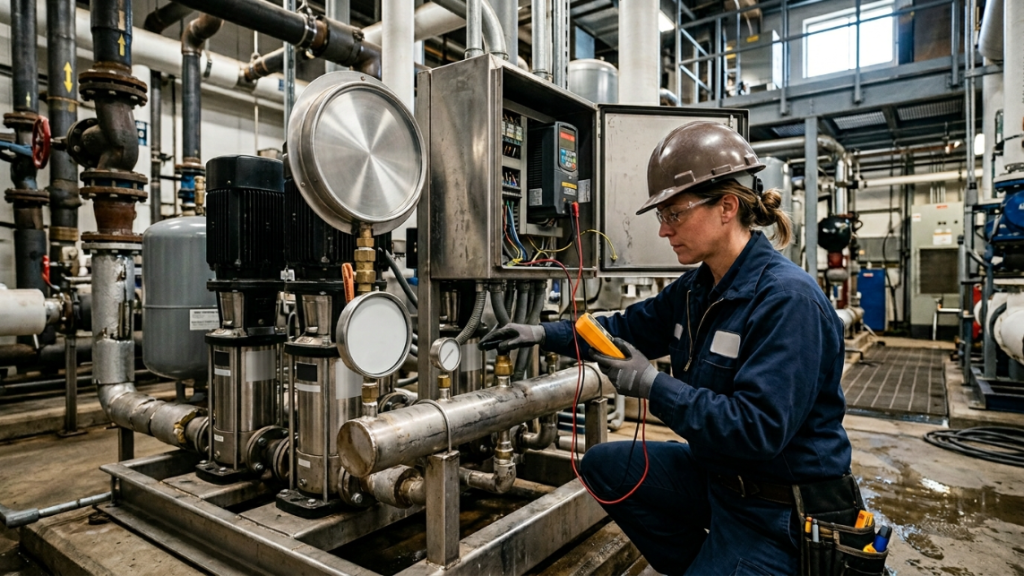
- Faulty pressure switch or corroded contacts: The small spring-and-wire device near the tank can have stuck or corroded contacts. Check your control panel for any error lights or fault indicators.
- Seized pump or burnt-out capacitor: If the breaker keeps tripping or the motor hums but doesn’t spin, you’re dealing with a deeper electrical or mechanical fault that requires expert diagnosis.
The Ghost in the Machine: The Constant “On Off” Cycling
Have you noticed your pump turning on and off every few minutes, even when no one is using water? This is known as short cycling, and it is a killer for pump motors. It drastically increases wear and tear and jacks up your electricity bill. The most common reason for this frantic behavior is a waterlogged pressure tank.
- Waterlogged pressure tank: The most common cause. The air bladder inside the tank ruptures or fills completely with water, losing its ability to cushion the system and give the pump a break between cycles.
- Faulty pressure switch: A malfunctioning switch causes the pump to react to the slightest pressure drop and kick on immediately, even without real demand.
- Small undetected plumbing leak (e.g., running toilet): A constant, small demand for water creates relentless short cycling. This problem needs immediate attention to prevent premature pump failure.
All Noise, No Action: The Pump Runs but No Water Comes Out
This scenario is particularly confusing and frustrating. You can hear the motor running, it sounds like it is working hard, but your taps are bone dry. When the booster pump not working results in no water flow, you likely have a prime issue.
- Loss of prime: An air leak on the suction line or a low water level in the source tank means the pump casing and suction line are no longer full of water, so the pump just spins uselessly without creating suction.
- Closed or blocked inlet valve: The valve before the pump may be accidentally shut or obstructed by debris, cutting off the water supply entirely.
- Reversed motor rotation (three-phase pumps): Incorrectly wired electrical phases cause the motor to spin backward. The pump runs but can’t move water — a complex issue requiring a technician to correct the power supply or mechanical seal.
Leaks And Puddles: The Warning Signs You Can’t Ignore
Sometimes the problem is not about the water coming out of your faucets, but the water ending up where it shouldn’t be: on your floor. Water leaking from the pump or its connections is a clear sign of trouble. Leaks are often caused by a failing mechanical seal, which is the component that seals the rotating pump shaft to the stationary pump casing.
Over time, these seals wear out, dry out, or crack, leading to a steady drip. While a small drip might seem minor, it can lead to major damage, including rust, electrical hazards, and even foundation issues if left unchecked. In some cases, leaks can also be caused by loose mounting bolts or cracked pipes from excessive vibration. If you see water pooling around your pump, don’t just mop it up and forget it. It is a cry for help from a system that is under stress and needs professional water booster pump repair.
The Overachiever: When The Pump Runs Constantly Without Stopping
If your pump motor runs 24/7 without ever shutting off, your system is in trouble and your electric bill is skyrocketing. This is the opposite of short cycling. This usually indicates that the pump simply cannot build enough pressure to satisfy the pressure switch’s cut off setting.
- Major main line leak: All the water the pump pushes out leaks back into the ground or a crawlspace, so the pump can never reach cut-off pressure and runs non-stop trying to keep up.
- Failed foot valve or check valve: If this valve is stuck open or broken, water slides back into the well or storage tank the moment the pump pauses. This constant running is a death sentence for a pump motor and requires an immediate diagnosis.
The Hot Mess: Dealing With Motor Overheating
Have you touched the pump motor and felt that it is alarmingly hot to the touch? While motors naturally get warm during operation, if it is so hot you can’t keep your hand on it, something is wrong. Booster pump problems related to heat are serious.
- Pump working too hard: Running against a closed valve or pushing water beyond its design capacity forces the motor to overwork and overheat.
- Poor ventilation: A poorly ventilated pump room traps heat around the motor, compounding the problem.
- Voltage issues (under-voltage or phase loss): Power supply problems cause the motor to draw excessive current. If you notice a burning smell or an extremely hot motor, shut the system off immediately to prevent fire or complete motor burnout — then call our team for an emergency inspection.
The Forgotten Maintenance: Why Prevention Is Better Than Repair
The truth is, many of the issues we’ve discussed can be avoided with a little TLC. The number one cause of water booster pump problems we see across NY, NJ, and PA is simply neglect. These systems are built to last, but they aren’t invincible. Regular maintenance is the key to a long and healthy pump life.
- Clean inlet strainers and filters regularly to ensure unrestricted water flow into the pump.
- Visually inspect the system every week for small leaks or unusual noises before they escalate.
- Check the pressure in the tank’s air bladder using a standard tire pressure gauge to confirm it is properly charged.
Just like a car needs oil changes, a booster pump needs professional attention. Scheduling a routine inspection with our experienced team can catch a minor issue before it turns into a catastrophic and expensive emergency.