It always happens at the worst possible moment, doesn’t it? You are already behind schedule, the building is fully occupied, or maybe there is a deadline looming for a critical process. You walk into the mechanical room, and you hear it. Or rather, you don’t hear it. The pump that should be running is silent.
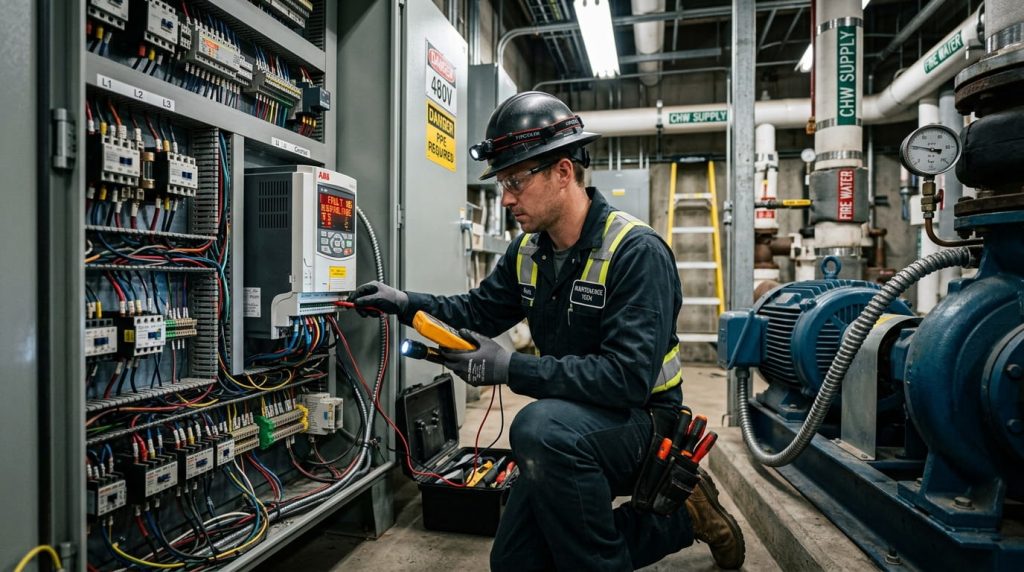
Or worse, it is making a sound that makes your stomach drop, that awful grinding or humming that tells you something is deeply wrong. You glance over at the variable frequency drive, that little box you were told would save energy and make everything run smoothly, and it is flashing a red light. VFD problems always seem to appear at the most inconvenient times.
A code you don’t recognize. Maybe it is completely dead. In that moment, panic starts to set in. I have been there with countless clients across NYC and NJ, standing in that exact spot, feeling that same pressure.
The good news? Most VFD problems are actually quite common, and many of them have simple explanations. You don’t need to be an electrical engineer to understand what is going on. Today, we are going to walk through the eight most frequent issues we see, so the next time that red light flashes, you know exactly where to look first.
What Is This Thing Again? A Quick Refresher on VFDs and Why VFD Troubleshooting Matters
Before we dive into the messy stuff, the faults and the failures, let’s take thirty seconds to remember what we are actually dealing with. If you are new to the world of pumps, or if you just need a quick reminder, understanding the basics helps make sense of the problems.
A VFD, or Variable Frequency Drive, is the device that controls the speed of your electric motor. Instead of running your pump at full tilt all the time, it adjusts the frequency of the power going to the motor so it only runs as fast as needed.
If you want a deeper dive, you can check out our previous post on what is VFD for pumps to get the full picture. But for now, just remember this: it is a sophisticated piece of electronics that takes power from the grid, conditions it, and sends it to your motor in a very specific way.
And because it is electronic, it can be sensitive. It hates heat, it hates moisture, and it hates electrical spikes. Keeping that in mind will help you understand why the list below is full of issues related to those very things.
When Your Drive Decides to Take a Nap (VFD Not Working)
Let’s start with the most terrifying scenario. You walk up to the panel, and there is nothing. No lights, no display, no hum, no nothing. It is completely dead. A VFD not working in this manner usually points to one thing: a loss of input power.
Before you call for an expensive service visit, do the simplest check first. Is the disconnect switch on? Did a breaker trip in the main panel? Believe it or not, we have responded to emergency calls only to find that a janitor or a maintenance worker accidentally bumped the disconnect switch to the off position. It happens.
If the power is on but the drive is still dark, you might be looking at a blown fuse or a failed rectifier inside the drive. The rectifier is the part that converts AC power to DC, and it can be damaged by power surges or simply wear out over time.
If you have confirmed that power is reaching the drive and it still won’t wake up, it is time to call in the pros for a proper VFD repair service. Messing around inside a live drive with a multimeter when you aren’t trained is a great way to get hurt or cause more damage.
Overvoltage And Undervoltage: When the Power Grid Plays Tricks on You
This is one of the most common variable drive issues we see, especially in older buildings here in New York City and parts of Pennsylvania. The drive is smart. It knows exactly how much voltage it is supposed to be getting. If the incoming power from the utility dips too low (under voltage) or spikes too high (overvoltage), the drive will shut down to protect itself and the motor.
Under voltage usually happens during peak usage times. Think about a scorching hot summer afternoon when every air conditioner in the tri state area is fighting for power. The grid gets stressed, and voltage sags. The drive sees this as a threat and trips out.
Overvoltage is often caused by events like the utility switching grids, or by something called “regenerative loading,” where the motor actually acts as a generator and sends power back into the drive when it slows down too quickly.
Checking the connections at the terminals to make sure they are tight is a good first step, but if the grid power is unstable, you might need to look into line reactors or other protection devices.
The Silent Killer: Overcurrent And Overheating Nightmares
If there is one thing that kills VFDs faster than anything else, it is heat. These devices are essentially computers, and computers hate getting hot. The “Overcurrent” fault is the drive’s way of saying, “Someone is asking me to do too much work.”
This is often caused by a problem with the motor or the pump itself. For example, if you have a seized bearing or a failing pump, the motor has to work harder to turn. It draws more current, and the drive says “Nope, I’m out.”
This is where you have to look beyond the drive and at the mechanical load. Is the pump spinning freely? Is there something caught in the impeller? Is the pump motor overheating and drawing excess current?
Also, check the drive’s cooling fan. Is it spinning? Are the air intake vents caked with dust and grime? We have pulled handfuls of lint and dirt out of drives located in boiler rooms and laundry facilities. If the fan is dead or the vents are clogged, the drive will cook itself from the inside out. Regular cleaning is cheap insurance.
Ground Faults and Short Circuits: When Electricity Goes Rogue
This one can be a bit more serious. A ground fault means that electricity is leaking out of the motor windings and going to earth ground instead of doing useful work. A short circuit means that the phases of power are touching each other directly. Both are bad news. When a drive detects this, it shuts down instantly to prevent a catastrophic failure and potential fire.
The culprit here is almost always the cabling or the motor. Insulation breaks down over time, especially in harsh environments. If you have water in a conduit, or if a rodent has chewed through the wire insulation, you will get a ground fault. The first step is to disconnect the motor from the drive and test the motor and the cable separately with a megger (insulation resistance tester).
If the motor checks out, the problem is in the wiring. If the motor shows a dead short, you are looking at a motor replacement. Ignoring a ground fault is dangerous, as it can lead to arcing and serious damage to your equipment.
Input Phase Loss: The Missing Puzzle Piece
Three phase power is called “three phase” for a reason. It relies on three separate waveforms of AC power, all perfectly timed. If one of those phases disappears, the motor will try to run on the remaining two, but it will do so very poorly. It will draw massive current, run rough, and overheat quickly. The drive detects this “phase loss” and shuts down to prevent a meltdown.
This problem usually points back to the utility, or to the wiring between your main service and the drive. A blown fuse on one leg, a loose connection in the main breaker, or a failed transformer down the street can cause a phase loss.
You can check the incoming voltage at the drive’s input terminals with a meter. If one leg reads zero or significantly lower than the others, you have found your smoking gun. This is one of those VFD problems that requires an electrician or a utility crew to fix, as it is upstream of your equipment.
When The Motor Acts Like a Jackhammer: Resonance and Instability
Sometimes, the drive isn’t throwing a fault code, but something just feels wrong. The motor might be making a loud humming noise, or the whole pump skid might be shaking and vibrating excessively. This is often a mechanical resonance issue. Every piece of equipment has a natural frequency.
When the VFD is running the motor at a certain speed, it can hit that frequency, causing the system to vibrate like a tuning fork. This is annoying and it can lead to premature failure of pipes, fittings, and the pump baseplate. The solution isn’t usually a repair, but a configuration change.
Most modern drives have a feature called “skip frequencies” or “critical speed avoidance.” You can program the drive to skip over the RPM ranges that cause the vibration, spending as little time as possible in that zone. It won’t fix a mechanical imbalance, but it can stop the drive from holding the motor at that specific damaging speed.
Communication Breakdown: When The Drive Won’t Listen
In modern facilities, the VFD isn’t just a standalone box. It talks to a central building management system or a pump control panel. It receives commands: “Run at 60%,” “Stop now,” “Go into sleep mode.” When that communication link breaks, you have a problem. The drive might run locally but won’t respond to remote commands, or it might show a “Comm Fault” on the display.
This can be caused by a few things. Wiring for communication cables is different from power wiring. It is sensitive to interference. If a communication cable is run too close to a high voltage power line, the electrical noise can corrupt the signal. Terminators might be missing, or the shield on the cable might be grounded incorrectly.
Sometimes, the issue is as simple as a bad ethernet cable or a loose screw on a terminal block. Checking the physical connections and making sure the addressing in the software is correct is the place to start.
The Solution at Your Fingertips: Don’t Go It Alone
Look, I get it. You are responsible for a lot. You have boilers, chillers, pumps, and a hundred other things demanding your attention every single day. When a drive goes down, it adds a massive headache to your already full plate. While the tips above will help you diagnose the issue and maybe even get you back up and running quickly, some problems are beyond the scope of a simple fix.
When you find yourself staring at a fault code you don’t understand, or when you have tried the basics and the drive still won’t cooperate, remember that you don’t have to figure it out alone. We have spent over eight decades standing in mechanical rooms just like yours, solving these exact puzzles.
Whether you need emergency support, a complex VFD troubleshooting session, or just a second pair of eyes, our team is ready. Don’t let a flashing red light ruin your day. Give us a call, and let’s get your system running smoothly again.