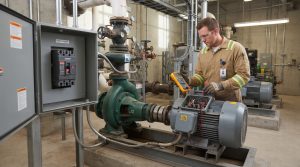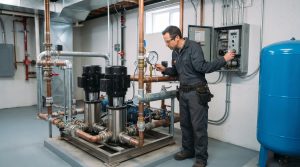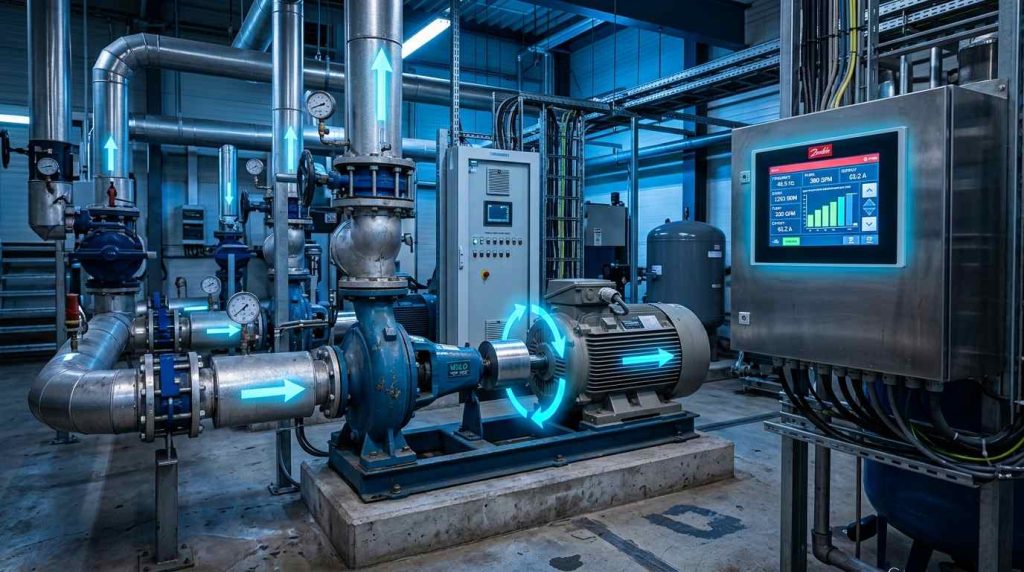
Have you ever stood in a mechanical room, maybe in a commercial building down in the Financial District or at an industrial site out in Jersey, and just listened? The hum of motors, the thrum of pipes, the constant draw of power – that is the heartbeat of your operation, and a VFD for pumps is what keeps it running efficiently.
But here is a question that keeps facility managers and plant supervisors up at night: is that heartbeat efficient, or is it slowly bleeding money every single second it runs? For decades, pumps were treated like on off switches. They ran at full speed, all the time, whether the demand was there or not.
It was like driving a car with the pedal permanently floored, using brakes to control your speed. It worked, but it was wasteful, noisy, and hard on the equipment. Then, technology caught up with common sense. Enter the Variable Frequency Drive. If you manage pumps of any size, from wastewater treatment to HVAC circulation, understanding this device isn’t just technical jargon; it is the key to unlocking serious savings and extending the life of your most critical assets.
Today, we are pulling back the curtain on what a VFD for pumps really is, why it matters for your bottom line, and how it changes the game for operations in NY, NJ, and PA.
What exactly is a variable frequency drive for pumps? Demystifying the magic box
Let’s keep this simple. Imagine you have a ceiling fan at home. It has pull chains that let you go from low to medium to high. You aren’t turning the motor on and off really fast to simulate a lower speed; you are actually changing the amount of power going to the motor to make it spin slower.
A variable frequency drive pump controller does the same thing, but for industrial sized motors and with incredible precision. In technical terms, a VFD is an electronic device that controls the rotational speed of an alternating current (AC) electric motor by adjusting the frequency of the power being supplied.
Most industrial pumps are designed to run at a fixed speed, usually 3,600 RPM. But your building or process doesn’t always need that much flow. Without a VFD, you have to restrict the output with valves, which is like stepping on the gas and the brake at the same time.
The VFD simply turns down the “gas.” It takes the incoming utility power, converts it, and sends out a new frequency that tells the motor exactly how fast to spin to meet the demand at that exact moment. It’s smart, it’s smooth, and it completely changes how you manage fluid movement.
The Pump Vfd Benefits That Actually Matter to Your Bottom Line
Alright, let’s talk turkey. Why should you care about installing one of these on your system? Because the pump VFD benefits go far beyond just having a cool piece of technology in your mechanical room. These are tangible, measurable improvements that impact your budget and your sanity.
First and foremost, we have to talk about energy. Pumps are energy hogs. In fact, pumping systems account for nearly 20% of the world’s industrial electricity consumption. When you run a pump at full speed all the time, you are paying for a lot of wasted energy. A VFD eliminates that waste.
By matching the pump output to the actual required load, you can see energy savings between 20% to 50%. That isn’t pocket change; that is real money going back into your operating budget. Then there is the wear and tear. Think about slamming a door versus closing it gently.
Every time a standard motor starts up, it experiences a massive jolt of current and mechanical stress. Over time, this leads to failures. VFDs offer something called “soft starting,” which gradually ramps up the motor speed. This reduces stress on the windings, bearings, and couplings.
This means fewer emergency calls, less downtime, and a longer lifespan for your high efficiency motors. You aren’t just saving on electricity; you are saving on future capital expenses.
Wait, how much can i save? Understanding vfd energy savings
I know, numbers can get boring fast, but stick with me here, because the VFD energy savings potential is actually pretty exciting. There is a principle in physics called the “Affinity Laws,” and it applies directly to centrifugal pumps. It sounds complicated, but the takeaway is simple: for a centrifugal pump, reducing the speed by just 20% can reduce the power consumption by a whopping 50%.
Let’s put that in perspective. If you have a pump that currently costs you $10,000 a year to run at full speed, slowing it down by just a fifth for a portion of its operating cycle can cut that energy bill in half. A recent study on industrial pumping systems showed that upgrading from a fixed speed system to a full VFD system led to energy cost savings of over 20% annually.
In one real world example, that translated to saving over $205,000 in a single year. Even a modest 10% reduction in flow with a VFD leads to more than a 25% reduction in energy use. When you look at it that way, the question isn’t whether you can afford a VFD; it’s whether you can afford not to have one.
Beyond The Motor: Smarter Control and Modern Integration
A VFD isn’t just a standalone box that changes speeds. In today’s connected world, it is the brain of your pumping operation. Modern VFDs act as a sophisticated interface between your pump and your building management system. They allow for precise control of pressure and flow using sensors, maintaining a perfect set point without the need for wasteful throttling valves or recirculation lines.
This intelligence allows for features like automatic cascade control, where the VFD manages multiple pumps, turning them on and off as needed to maintain pressure across a large system. They can also feed real time data back to you. You can monitor vibration, temperature, and power consumption remotely.
This data is gold for predictive maintenance. Instead of waiting for something to break and scrambling for a VFD troubleshooting guide at 2:00 AM, the system can tell you when performance starts to dip, allowing you to schedule repairs before a catastrophic failure occurs. It takes you from a reactive mindset to a proactive one.
Is your system ready? A look at integration and hardware
Of course, you can’t just bolt a VFD onto any old motor and expect magic. Integration is key. When we talk about retrofitting or designing new systems, we have to look at the whole picture. The VFD communicates with the motor, but it also relies on the rest of the infrastructure.
For example, a proper setup includes a well-designed pump control panel basics foundation. The panel houses the VFD, the breakers, the controls, and the interface that lets your team actually interact with the system.
Furthermore, you have to consider the motor itself. While many motors can be retrofitted, pairing a VFD with a modern, high efficiency motors designed for inverter duty is the ultimate combination. These motors are built to handle the specific voltage spikes and cooling demands that come with VFD operation, especially at lower speeds.
If you are dealing with an older system, a professional assessment is crucial. You want to make sure that the entire drive train, from the electrical supply to the pump shaft, is ready to handle the sophisticated control a VFD provides. And when the time comes for upgrades or repairs, having access to expert VFD service ensures your investment keeps paying dividends for years to come.
Why Your Pumps Are Ready for A Vfd Upgrade Right Now
Look, the days of brute force pumping are over. In a city that never sleeps, where every square foot of commercial space and every industrial process needs to be optimized, wasting energy and abusing equipment is a luxury none of us can afford.
A VFD for pumps transforms a simple motor into a responsive, intelligent, and efficient workhorse. It saves you money on your electric bill, it saves you money on maintenance, and it gives you peace of mind through better data and control. Whether you are running a high rise in Manhattan or a processing plant in Pennsylvania, this technology isn’t just a nice to have; it is the standard for responsible, modern operation.
If you haven’t looked at your pumping strategy lately, now is the time. Let’s bring your systems into the 21st century, protect your assets, and stop wasting power. Your equipment, and your finance department, will thank you.